A Boy Growing Up in Molina
Growing up in Molina in the early 1960s meant knowing where you belonged. We did not have organized gangs with officers, membership cards, or rules. We had neighborhoods. Molina was ours, and other boys belonged to Prescott Village, La Arboleda, La Cuarenta, Chula Vista, Los Encinos, and other parts of Corpus Christi. Everybody understood that invisible boundaries separated one neighborhood from another.
Crossing those boundaries was not always dangerous. If you knew somebody in the neighborhood, you had a reason for being there. But wandering into somebody’s backyard or down one of the back streets without knowing anyone was almost like asking for a fight. A boy might be challenged simply because nobody recognized him. The first questions were often not about what he had done, but where he lived and whom he knew.
The newspapers called these groups “teenage gangs,” but even the juvenile judge questioned that description. After a large fight in Molina in March 1961, Judge Paul A. Martineau said he was not sure organized gangs were involved. That was closer to the truth. Most of the boys were not members of criminal organizations. They were neighborhood boys who could be drawn into a fight because somebody said their barrio had been insulted.
I was in junior high when a boy I knew told me that a fight was coming and asked me to go support our barrio. I think I was in the eighth grade. I asked him who we were fighting, and I believe he said La Arboleda. Then I asked the obvious question: Why were we fighting them? He told me he did not know.
I did not go. Why would I fight someone I did not know for a reason nobody could explain? To be honest, at 12 years old, there was no way my father was going to let me go out late at night. But there is no way I was going to tell the guy that.
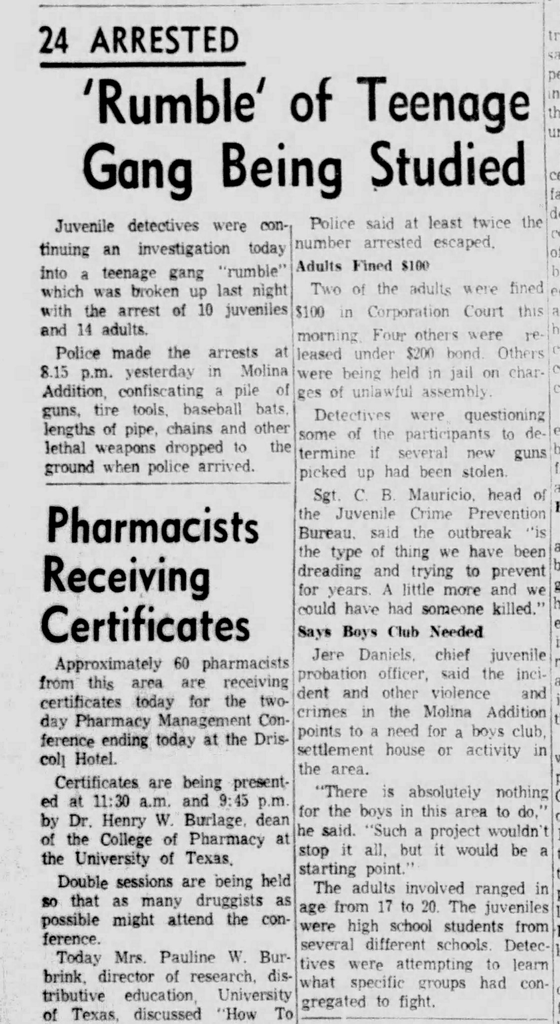
The fight took place in Molina on the evening of March 22, 1961. Police arrested ten juveniles and fourteen young men between seventeen and twenty years old. The newspaper reported that officers collected clubs, chains, knives, tire tools, pipes, baseball bats, and two guns. Police believed at least twice as many boys escaped. I could easily have been among the younger boys caught in that crowd, except I had asked one question too many—or perhaps exactly enough.
My decision did not make me typical of every boy in Molina, but neither were the boys who went to the fight typical of everyone else. Most Molina children were not roaming the streets looking for trouble. Many of us had protective parents who wanted to know where we were, whom we were with, and when we were coming home. Some parents were strict because they understood how quickly a Mexican or Black boy could acquire a reputation that might follow him through school, the police station, and the courts.
Molina children played baseball and football wherever we could find enough open ground. We explored the ditches, walked the streets, visited friends, and made our own entertainment because the neighborhood offered very little organized recreation. After the 1961 fight, juvenile probation chief Jere Daniels said there was “absolutely nothing” for the boys in Molina to do. He argued that the neighborhood needed a boys’ club, settlement house, or some other place where young people could gather.
The lack of recreation did not turn every boy into a criminal. It did, however, leave young people to create their own world, with its own meeting places, loyalties, and boundaries. Sometimes those loyalties produced friendships and pride. Sometimes they produced fights whose original causes had been forgotten before the first punch was thrown.
The territorial fights continued. In 1963, a boy walking near Prescott and Horne was asked whether he lived in Prescott Village. When he said yes, he was beaten. Another youth had been shot the previous week by boys who said they were from Molina and were seeking revenge for an earlier beating involving a Prescott teenager. Nobody needed a formal gang name. Saying “Molina” or “Prescott” was enough.
That was part of growing up in Molina: knowing where you were, where you could go, and when someone else’s quarrel was trying to become yours. I was proud of my barrio, but pride did not require me to surrender my judgment. When someone asked me to fight, I wanted to know whom we were fighting and why.
When nobody could answer why, I stayed home.