Listen to the story
Going backward has been the best way to trace my ancestors: census records, birth records, baptisms, and marriages. Along the way, I found that my father had a step-sister I didn’t know about. I have not found her, other than her birth; I hope one day someone takes a DNA test that will lead me to her and what happened to her after her mother died, who raised her, and who she married. Death certificates tell me what most of my close relatives have died from. Other information has led me to discover who has served our country. Ever since I watched Roots years ago, I’ve wanted to learn about my ancestors. After I retired about 15 years ago, I started searching; I am still searching. Little by little, I discover more about who my ancestors were.
Before They Followed the Cotton: The García Family’s Life in South Texas Ranch Country
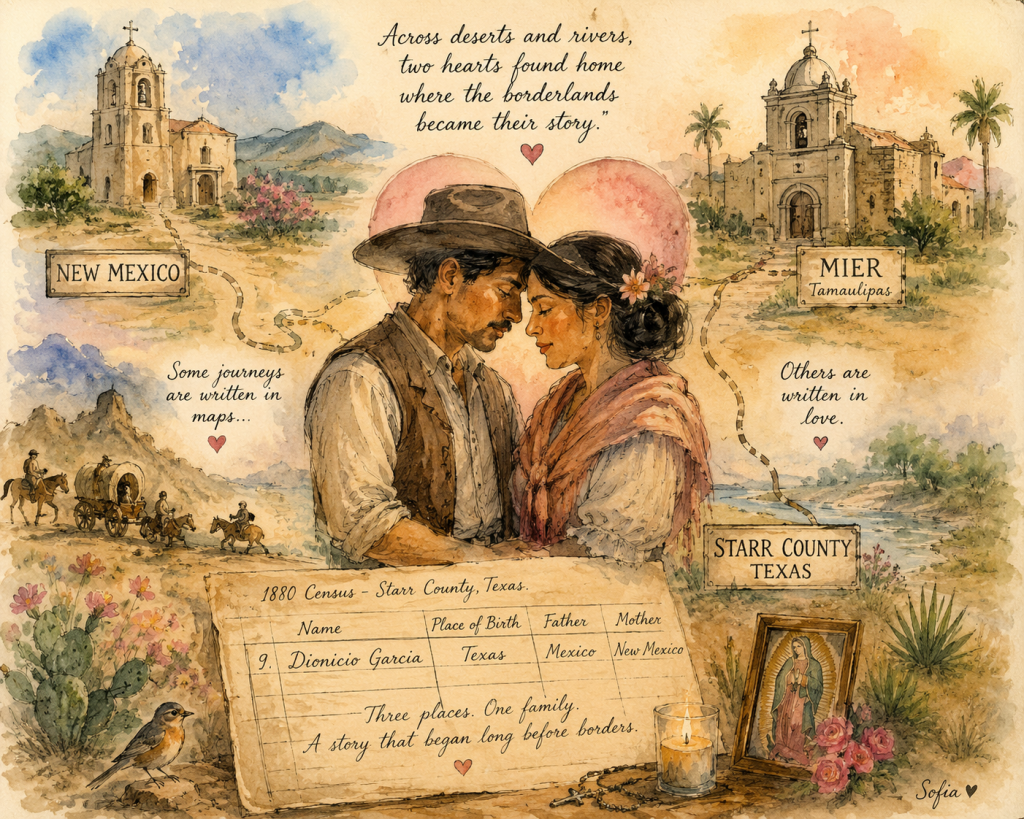
In 1870, the United States census found Eduardo García, born about 1845, living with Juana García and their infant daughter Bartola at Las Escobas in Starr County. The census identified Eduardo simply as a “servant.”
Ten years later, another census gave his work a more specific name: Eduardo García was a cattle herder.
Those two census entries open a window into the García family before they became tenant farmers and migrant laborers. Their earlier history belonged to the ranches, cattle, and border communities of nineteenth-century South Texas.
A servant at Las Escobas
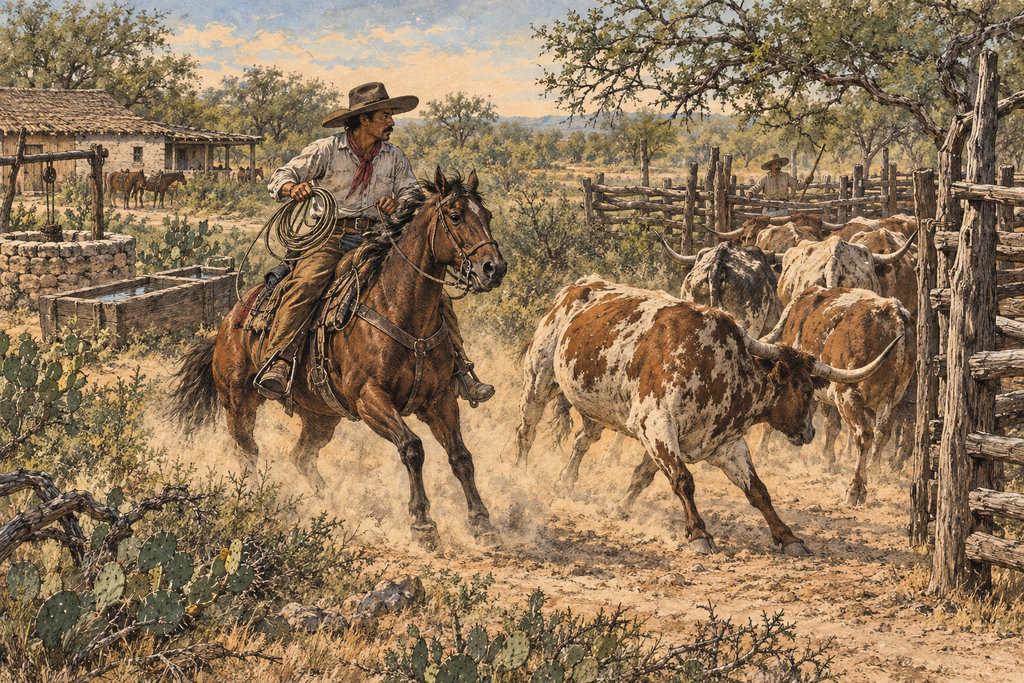
Las Escobas was not merely the name of a census district. It was a Spanish-speaking ranching community on Las Escobas Creek, about twenty-two miles north of Rio Grande City. It stood on land originally granted during the Spanish colonial period, long before the Río Grande became the boundary between Mexico and the United States.
The ranch at Las Escobas was associated with José Felipe Guerra Hinojosa and his wife, María Josefa González García. According to the Guerra-Salinas family history, the couple operated the ranch from Roma for approximately twenty years before beginning construction of their ranch headquarters around 1865. They then moved their family to Las Escobas, where relatives and working families lived nearby and contributed to the work of the ranch. The surviving family account describes a large operation with cattle pens, wells, watering places, and ranch hands.
Eduardo appeared there in the 1870 census while that ranch headquarters was still being built. The word “servant” does not tell us his precise duties, and it should not automatically be interpreted as domestic service. On an isolated ranch, a male servant might perform many kinds of work involving livestock, horses, wells, fences, construction, or general maintenance.
The 1880 census provides the strongest clue. By then, Eduardo’s occupation was recorded as cattle herder. That does not prove that every task he performed in 1870 involved cattle, but it makes it reasonable to believe that the “servant” of 1870 was already part of the ranch workforce.
The evidence is strong that Eduardo worked within the Las Escobas ranching community. It is also likely that he worked for the Guerra operation because the Guerra family controlled the ranch and lived there. However, the census did not name Eduardo’s employer, and no payroll, contract, or account book has yet been found that directly identifies who paid him.
Ranching became a García family occupation
Eduardo’s work was not an isolated entry in a single census. His son Dionicio García, born about 1872, also became a herder. Another García family member, Wenceslao García, later worked as a government cattle inspector, a position that may have drawn upon knowledge developed through the family’s years around livestock.
Across at least two generations, the García men possessed skills needed in the ranching economy. They knew cattle, horses, water sources, trails, and the South Texas brush country. Herding was not simply walking behind animals; it required recognizing brands, finding scattered livestock, handling animals in pens, protecting herds, and moving them through a harsh landscape where water could determine whether cattle lived or died.
The history of Las Escobas helps us imagine the physical setting without pretending that we know Eduardo’s exact daily routine. The ranch used corrales de leña—heavy cattle pens constructed from mesquite—and depended upon hand-dug wells and a central watering place. Ranch hands pulled water one bucket at a time and poured it into troughs, drawing the livestock back toward the headquarters where the cattle could be worked.
The García family’s occupations place them inside that world.
The river was a boundary, but it was also part of their country
The García records sometimes place family members in Texas and sometimes connect them to Mexico. That movement should not automatically be treated as permanent immigration in the modern sense.
The Río Grande had been the international boundary since 1848, but the ranching communities on both banks were older than the border. Families, churches, cattle trails, employers and customs extended across the river. People crossed at familiar fords or traveled by ferry or small boat; they did not necessarily make their way to a modern international bridge with passports and inspection booths. The National Park Service notes that settlements and camps developed around commonly used Río Grande fords and ferry crossings because travelers often had to wait for safe water conditions. River crossings were a normal and necessary part of life in the region.
If a modern reader needs an image, the world was closer to Lonesome Dove than to today’s controlled ports of entry. A rider who needed to cross the river looked for a known crossing place and judged the current. The river could be dangerous, but crossing it did not necessarily mean abandoning one country and beginning an entirely separate life in another.
The records of Eduardo García, born in 1896, illustrate the difficulty of imposing modern categories on a border family. He was Dionicio’s son and the grandson and namesake of the Eduardo García found at Las Escobas. Most census records and his death certificate identify Texas as his birthplace, but his World War I draft registration identifies Mexico and names Dionicio García as his relative.
We cannot determine from those conflicting records on which bank Eduardo was born. The contradiction might have resulted from an enumerator’s assumption, an informant’s mistake or the family’s movement through the border country. What the records establish is uncertainty—not permission to choose whichever birthplace best fits the story.
Ranching did not simply disappear
It would be wrong to say that cattle herding ended in Starr County and was replaced overnight by farming. Ranching remained important well into the twentieth century.
In 1860, Starr County reported 4,639 cattle and more than 19,000 sheep on seventy-one ranches. During the late 1880s, Felipe Guerra alone reported 25,000 acres and 980 cattle. As late as 1910, the county’s cattle population reached 85,425. The Handbook of Texas history of Starr County makes clear that crops expanded without immediately replacing livestock.
What changed was the structure of the economy. Land was fenced and consolidated, large estates were divided or reorganized, livestock became more closely regulated, and commercial agriculture required increasing numbers of seasonal workers. Open-range knowledge remained valuable, but fewer families could depend upon herding as their principal occupation.
Wenceslao García’s employment as a government cattle inspector may represent one response to that transformation. Knowledge once used primarily on a ranch was now also needed by a government system concerned with ownership, movement, disease, and commercial livestock regulation.
For other García descendants, the new agricultural economy offered a different kind of work—one that gave laborers less independence and little economic security.
From cattle to cotton
The growth of farming in Starr County can be measured. In 1860, the county had only seventy-one farms. By 1900 it had 382, and by 1910 it had 918. Cotton acreage increased from 1,615 acres in 1900 to 14,339 acres only ten years later.
Again, cattle did not vanish. Ranching and commercial farming existed together. But as cultivated acreage increased, more workers found themselves renting land, farming someone else’s property or selling their labor by the day and season.
That change appears in the García family records. In the 1940 census, Eduardo García, born in 1896, was identified as a tenant farmer. He worked the land, but he did not own the farm. By 1950, the census described him as a farm laborer.
Those two entries mark another important transition. His grandfather Eduardo had worked as a servant and cattle herder. His father Dionicio had also been a herder. Eduardo, the grandson, became a tenant farmer and then an agricultural wage laborer.
The family moved from caring for another man’s cattle to cultivating another man’s land and finally to selling its labor wherever crops were ready to harvest.
“Cheap and plentiful”
The agricultural developers who promoted the Lower Río Grande Valley understood that their profits depended upon inexpensive labor. They did not hide that fact.
A circa-1928 Valley Developments advertisement promised prospective investors:
“Mexican Labor—Cheap and plentiful—wages $1.50 a day, ten hours.”
Earlier promoters likewise described Mexican labor as cheaper and more dependable and assured investors that the supply from Mexico was practically unlimited. The language appears in historical research on the deliberate creation of the Valley’s commercial image and economy. The labor supply was promoted to investors as one of the region’s financial advantages.
That advertising reveals the purpose of the system. Mexican and Mexican-American workers were valued, but their poverty was also useful. Their skill and endurance made commercial agriculture possible, while their low wages helped landowners and investors keep a larger share of the profits.
The García family did not simply decide one morning to exchange ranch work for tenant farming and migrant labor. Their occupational changes followed the transformation of South Texas itself. Land ownership became more concentrated, fencing altered ranch work, commercial agriculture expanded, and employers built an economy around a labor force expected to work long hours for little money.
Before the migrant trail
The later chapter of this family history is already known. Eduardo García and his family followed agricultural work through Texas and traveled as far as Michigan. His daughter Otalia García Barrera remembered the truck that carried the family, the cotton fields and the constant search for the next crop. That part of the family’s history is told in “My Mother’s Story: Otalia García Barrera.”
But migrant labor was not the beginning of the García story.
Before the truck, there were horses and cattle. Before the cotton fields, there were the mesquite corrals and watering places of Las Escobas. Before Eduardo García became a tenant farmer and farm laborer, his father and grandfather had worked as herders, and Wenceslao García had carried the family’s livestock knowledge into government service.
The 1870 census called the elder Eduardo García a servant. The 1880 census called him what he had probably become—or perhaps what he had been doing all along: a cattle herder.
Those few words preserve a history that nearly disappeared. They show that the García family did not enter South Texas history only as poor migrant workers. They had already spent generations helping sustain the ranching economy of the borderlands. When that economy changed, the family changed with it—not because their capacity for work disappeared, but because the people who controlled the land found new ways to use it and new ways to profit from their labor.