West Oso has never been one of Texas’ wealthy school districts. It served working-class families on the edge of Corpus Christi, many of them Mexican American and Black, and much of its history unfolded far from the attention given to bigger and richer districts.
But there was a period when little West Oso was ahead of much of Texas.
It did not happen because the district had money. It happened because the people of Molina organized, voted, fought for representation, and changed who controlled their schools.
Before the change
West Oso had participated in segregation like other Texas school systems. In the 1950s, Black children attended separate schools or were sent elsewhere for certain grades.
One of the newspaper clippings I found shows that in 1955 the West Oso board voted to admit Black students to West Oso High School. Approximately twenty Black students in grades ten through twelve were affected. Younger Black children continued attending Carl Allen School, so this was not yet complete integration.
Another clipping from 1956 reported that West Oso had 219 Black students.
The change was coming gradually.
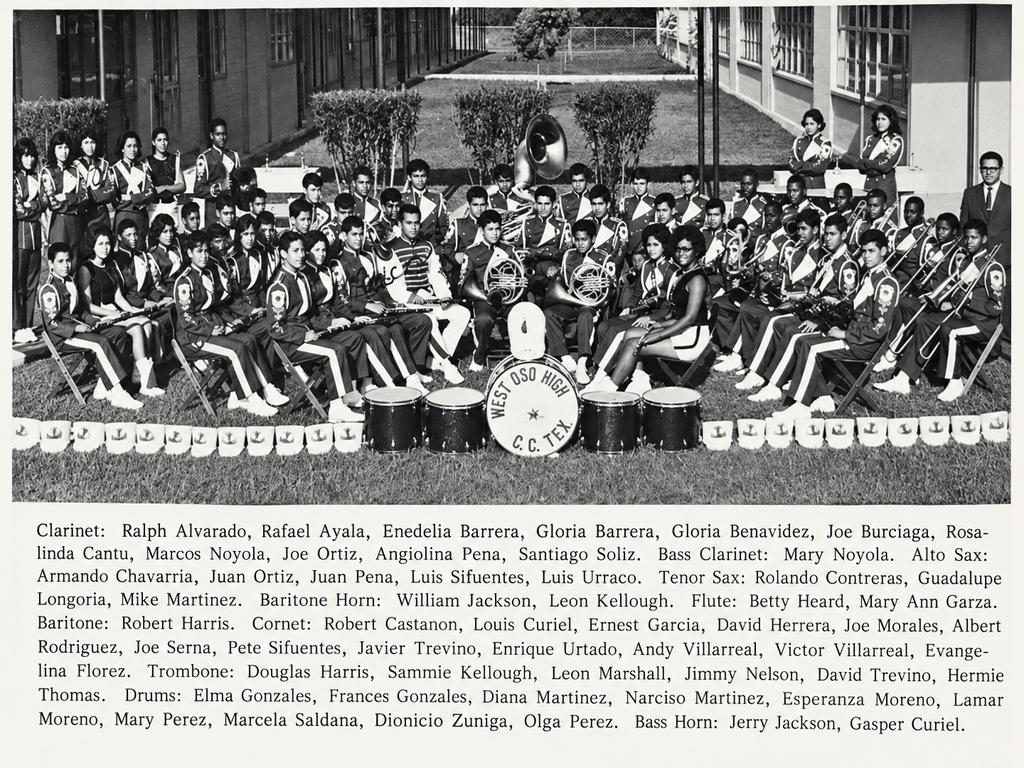
I remember something that the official records do not completely capture. Around 1961, when I was in sixth grade, Black and Mexican-American children were already playing together in band. We were still living within a school system that had remnants of segregation, but in band we were together.
Unfortunately, the junior-high yearbooks that might document those years were destroyed during the 1970 hurricane.
The earliest yearbook I still have is from 1965.
And there it is.
A photograph of the West Oso band shows Black and Mexican-American students sitting together in uniform, playing together as one band. Their names are printed beneath the photograph.
By 1965, at least, integration at West Oso was not merely something written in a school-board resolution. You could see it in the children.
Molina decided it wanted a voice
The larger transformation came through politics.
Residents of Molina had spent years organizing around the problems of their neighborhood. They fought for utilities, streets and other basic services. They organized poll-tax drives and voter-registration efforts. The Molina Civic Association became an important vehicle for turning a neglected community into a political force.
Then came 1963.
An August 1963 newspaper article reported something that had never happened before in West Oso Independent School District:
Latin Americans, almost all of whom lived in Molina, had elected a majority of Latin Americans to the West Oso school board for the first time.
Two Anglo trustees resigned. They complained that the board was being dominated by the Molina Civic Association.
Whatever one thinks of that accusation, it tells us something important.
Molina had acquired political power.
Historian Moisés Gurrola later described 1963 as the year of the “West Oso School Board Revolution.” His research documents the poll-tax drives and write-in campaigns that helped Molina residents gain control of the board. (Texas State Historical Association)
This was not merely Mexican Americans replacing Anglos and taking everything for themselves.
After the two Anglo trustees resigned, the new board appointed two Anglo residents to fill their seats. Board president Amador Gutierrez told the newspaper that the appointments meant the board now represented the entire West Oso district.
That is worth remembering.
The people who had fought to gain representation also understood that representation had to include somebody besides themselves.
Then West Oso moved quickly
The consequences of the 1963 election became apparent almost immediately.
The new board removed Superintendent Noel Reed and elevated Dr. John W. Skinner, who had become an ally of Molina residents. Gurrola’s research shows that Skinner pushed for full integration, elimination of attendance boundaries that had separated Black and Mexican-American children, and increased hiring of Black and Mexican-American educators. (UNT Digital Library)
Then came one of the most remarkable decisions.
In 1964, West Oso voted to integrate its ten Black teachers into formerly all-white faculties.
One of the newspaper headlines said simply:
WEST OSO TO INTEGRATE ITS 10 NEGRO TEACHERS
The article described West Oso as the first school district in the immediate Corpus Christi area to do so.
The United States Commission on Civil Rights noticed. Its 1964 report specifically recorded that West Oso had voted to place its ten Black teachers among formerly all-white faculties. (U.S. Commission on Civil Rights)
Consider the timing.
That decision came in 1964, while many Texas school districts were still resisting faculty integration. As late as 1965, reporting cited by the Texas Observer found that twenty of twenty-one Harris County superintendents surveyed were reluctant to integrate their faculties unless required to do so. Black teachers elsewhere were sometimes losing their jobs when segregated schools closed rather than being transferred into previously white schools. (Texas Observer)
West Oso chose a different course.
Black political representation followed
The changes were not confined to classrooms.
In 1964, Welder Brown was elected to the West Oso school board, becoming the district’s first African-American trustee. Two years later, in 1966, Brown became board president by acclamation and the first African-American school-board president in Nueces County. (Texas State Historical Association)
Think about what had happened in only a few years.
A school district that had operated segregated schools now had a Mexican-American majority on its board, an African-American trustee, integrated teachers, and increasingly integrated students.
That did not happen because someone in Austin or Washington suddenly discovered Molina.
People in Molina organized and changed their own government.
They changed where the schools were built
For Molina families, integration was not simply a question of who sat beside whom in a classroom.
It was also a question of geography.
For years, children from Molina traveled toward the more rural Anglo side of the district. After Molina residents gained influence, the district redrew attendance boundaries and began planning a new high school closer to the population it actually served. Gurrola’s research connects those decisions directly to the new board. (Texas State Historical Association)
The new Bear Lane campus opened as West Oso High School in the fall of 1969. The district itself records that date in its history. (westosoisd.net)
I graduated in 1967, so I never attended high school there.
My younger brother did.
For my generation, the new school came just a little too late. But for the children who followed us, the school district had physically moved closer to Molina.
That was no small accomplishment.
West Oso kept moving
The story did not end with desegregation.
By 1973, West Oso board president Roberto Gutierrez was advocating something else that was still controversial in many places: bilingual education.
In a surviving letter, Gutierrez supported expanding bilingual education from kindergarten through the twelfth grade, with the goal that West Oso students would leave school bilingual. (Omeka)
Federal records from the same year show West Oso receiving funding for a bilingual-bicultural education project. (ERIC)
The same community that had fought for political representation was now arguing that speaking Spanish should not be treated merely as a problem to be eliminated.
It could be an educational asset.
Poor district, rich history
West Oso never had the money of Texas’ wealthy suburban school districts.
What it had was Molina.
It had Black families who demanded that their children receive equal treatment. It had Mexican-American veterans and neighborhood organizers who understood that complaining about government was not enough; you had to vote, organize, and sometimes take control of it.
It had people willing to knock on doors and persuade their neighbors to pay the poll tax so they could vote.
It had parents who wanted their children to attend decent schools closer to home.
And for a remarkable period in the 1960s, those people moved a small South Texas school district ahead of much of the state.
The story should not be romanticized. West Oso had segregated children. Its early desegregation was incomplete. Black educators had previously suffered under the old system, and Mexican-American families had spent years without representation proportional to their numbers.
That is precisely why what happened afterward matters.
West Oso did not begin ahead of its time.
Its people pushed it there.
Those of us who attended West Oso remember teachers, football games, band practice, classmates, and buildings that may no longer even exist.
There is another part of West Oso worth remembering.
In one of the poorer school districts in Texas, Black and Mexican-American families organized together, changed who governed their schools, integrated students and teachers, brought people who had long been excluded into positions of authority, and moved their schools physically closer to the community they served.
West Oso did not have much money.
But for a moment in Texas history, it had something many richer districts did not have:
the courage to move first.
1965 West Oso Band