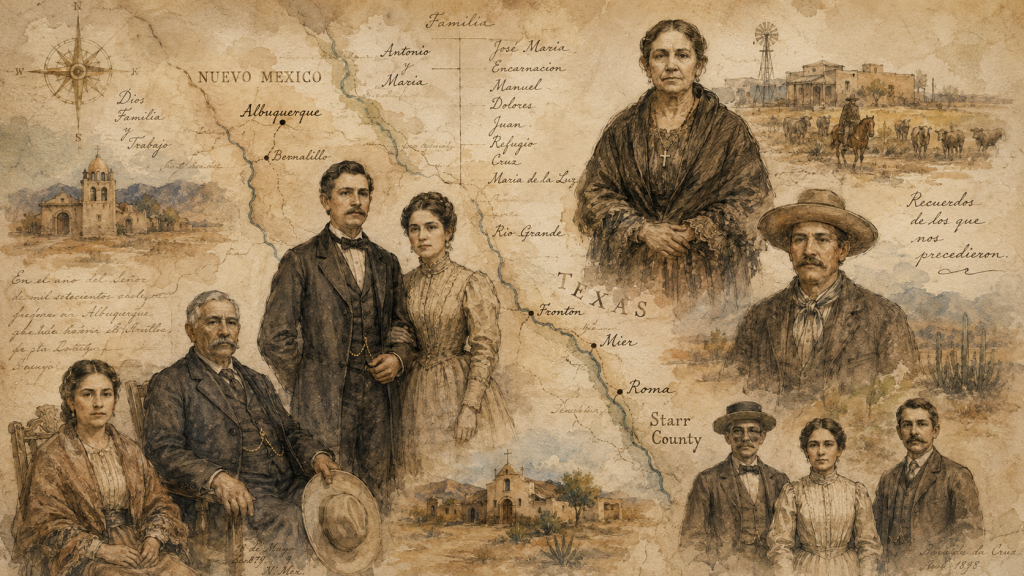
When I began tracing the Barrera side of my family, I expected to find baptisms, marriages, births, and deaths. What I did not expect was to find my ancestors already woven into the history of Mier almost from the beginning.
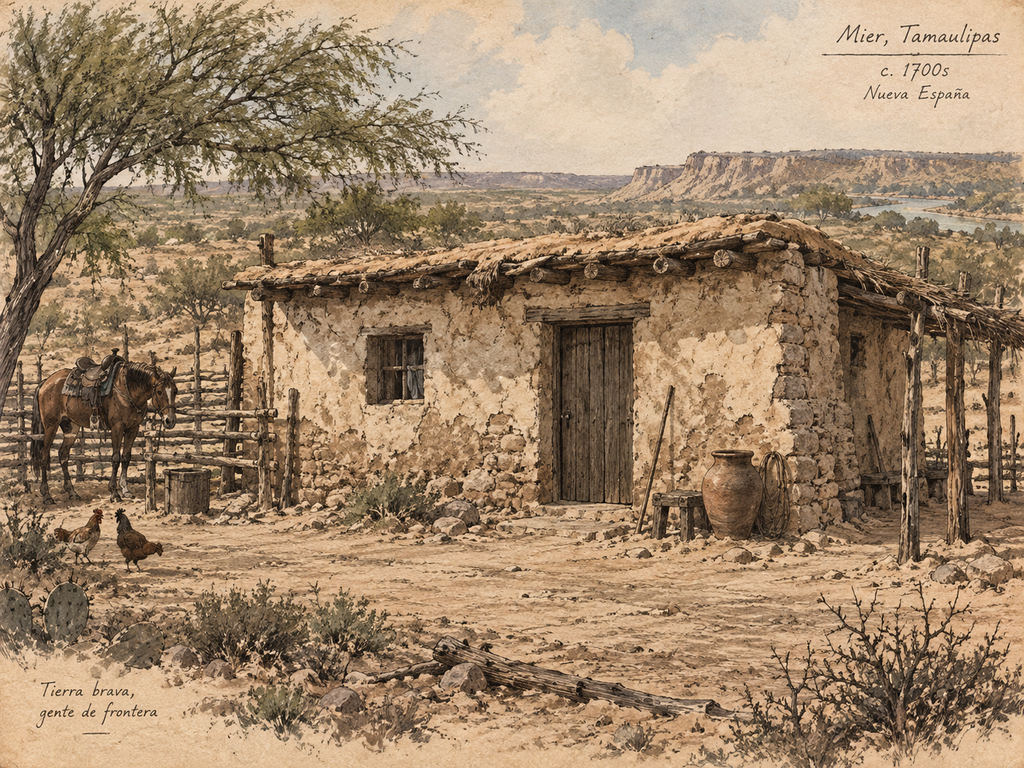
Mier was founded on March 6, 1753, by José de Escandón at a place called Paso del Cántaro. Families from Camargo and Cerralvo were brought into the new settlement, and Captain José Florencio Chapa was given political and military authority. By 1757, the population had grown to 39 families and 274 people. The official history of Mier says the houses were scattered and generally built of mud and stone or wooden posts plastered with mud. Only the captain had what was described as a substantial lime-and-stone house. (tamaulipas.gob.mx)
This was not yet the picturesque old border town people know today. It was a small frontier settlement surrounded by enormous distances, brush country, livestock, and uncertainty. Its economy depended heavily on ranching. Residents sold tallow, wool, and hides, using the proceeds to buy the corn they could not produce themselves. (tamaulipas.gob.mx)
My Barrera ancestors entered that world during its first generation.
One of them was José Santiago Barrera. By the late eighteenth century, Santiago Barrera was not simply another resident of Mier. The official history of the town identifies him as a lieutenant in the colonial militia and justicia mayor between 1780 and 1784. During his tenure, he ordered work begun on the town church. (tamaulipas.gob.mx)
That title sounds impressive today, but on the eighteenth-century frontier it also meant responsibility. A justicia mayor was involved in local government and justice, while a militia lieutenant belonged to a system in which ordinary settlers were expected to help defend their communities. Nuevo Santander did not have a modern police force or a large permanent army stationed in every town. Much of the burden of defense fell upon local men who left their homes, mounted horses, and joined their neighbors when trouble came.
Life depended on livestock, water, and weather
The settlers at Mier lived in a country where water determined almost everything. The climate was dry, temperatures could be extreme, and rainfall was unreliable. Even today, the Mexican government describes Mier as having a very dry climate with extreme temperatures. (gob.mx)
For an eighteenth-century ranching family, drought could mean more than inconvenience. It could mean dead animals, failed crops, and hunger. Cattle, sheep, goats, horses and mules represented both food and wealth, but they required water and grazing land. Ranchers had to know where water could be found, how long animals could travel between sources, and which trails remained usable during different seasons.
The Río Grande and its tributaries were therefore both lifelines and dangers. The river could provide water and a route between communities, but floods could make crossings impossible and destroy property. Low water might expose a familiar ford; high water could turn the same crossing into a deadly current.
That helps explain why places such as Paso del Cántaro mattered. A crossing was not merely a point on a map. It was part of the local knowledge necessary to survive.
Ranching was not peaceful work
There is a tendency to imagine Spanish colonial ranching as men calmly riding horses beneath a wide sky. The reality was more demanding.
Animals wandered. Cattle had to be gathered, counted, branded, treated, and moved. Horses could be stolen or lost. A rider thrown from a horse far from town could be badly injured with little chance of immediate medical help. Thorn brush, heat, snakes, and long distances were everyday hazards.
The ranching frontier was also expanding. By the 1760s, ranchers from settlements along the Río Grande were pushing farther north in search of grazing land. The Texas State Historical Association notes that ranchers from Camargo were already moving into what became the Nueces country during that period. (tshaonline.org)
That expansion brought Spanish and Hispanic settlers into increasing conflict with Indigenous peoples whose territories, hunting grounds, and movement routes were being disrupted.
The old Spanish documents often describe these Native groups simply as hostile or as bárbaros. That language reflected the viewpoint of the colonists. From the Indigenous perspective, Spanish settlements, missions, livestock, and land claims were intruding into territory their people had long used.
Both realities can be true at the same time. Colonial expansion dispossessed and pressured Native communities, and frontier settlers also faced genuine danger from raids and attacks.
The official history of Mier later recorded that Indigenous people associated with its mission had been considered valuable defenders against raids that frequently struck the frontier. (tamaulipas.gob.mx)
So Santiago Barrera’s militia rank was not merely a ceremonial decoration on a genealogy chart. It belonged to a frontier where settlers sometimes had to defend homes, livestock, and travelers.
Trouble could come without warning
Historical accounts from Nuevo Santander describe attacks on ranches and settlements, livestock theft, armed resistance, and captives being taken. Those incidents did not happen every day, but they were real enough that local defense mattered.
A family living outside the center of Mier would have been especially vulnerable. There were no telephones, patrol cars, or emergency services. If riders appeared on the horizon or livestock disappeared, help depended upon neighbors, relatives and the local militia.
That made extended family much more than a social relationship.
The Barreras married into Ramírez, García, Chapa, Hinojosa and Guerra families. Those connections could provide workers, witnesses, godparents, credit, food, transportation, and protection. When there was no government agency nearby to solve a problem, the people most likely to help were often relatives.
Family was infrastructure.
Disease was probably a greater danger than violence
Raiders and fighting make dramatic history, but disease likely killed many more people.
There were no antibiotics, no modern sanitation systems, and no reliable medical care. A fever could kill an otherwise healthy adult. A wound could become infected. Contaminated water could cause intestinal disease. Infants and small children died at rates difficult for us to imagine today.
Childbirth was especially dangerous.
One of the records I recently examined while researching another branch of the family involved a woman who died de parto — in childbirth. It was a reminder that birth itself could be a life-threatening event.
If someone became seriously ill on a distant rancho, there might be no physician nearby. A relative might have to ride into Mier looking for assistance while the sick person waited at home.
That isolation must have shaped how people thought about one another. Neighbors and family were not optional. Survival could depend on them.
Mier was part of a much larger family world
Saying that somebody lived in Mier does not necessarily mean that person spent every day inside the small settlement.
The town was surrounded by ranch lands, porciones and smaller communities. Ranch headquarters could be miles away. People traveled between Mier, Camargo, Revilla, Cerralvo and other settlements, following livestock, family, trade and land.
The same movement eventually extended across what became the international boundary.
That is where an old family memory becomes especially useful.
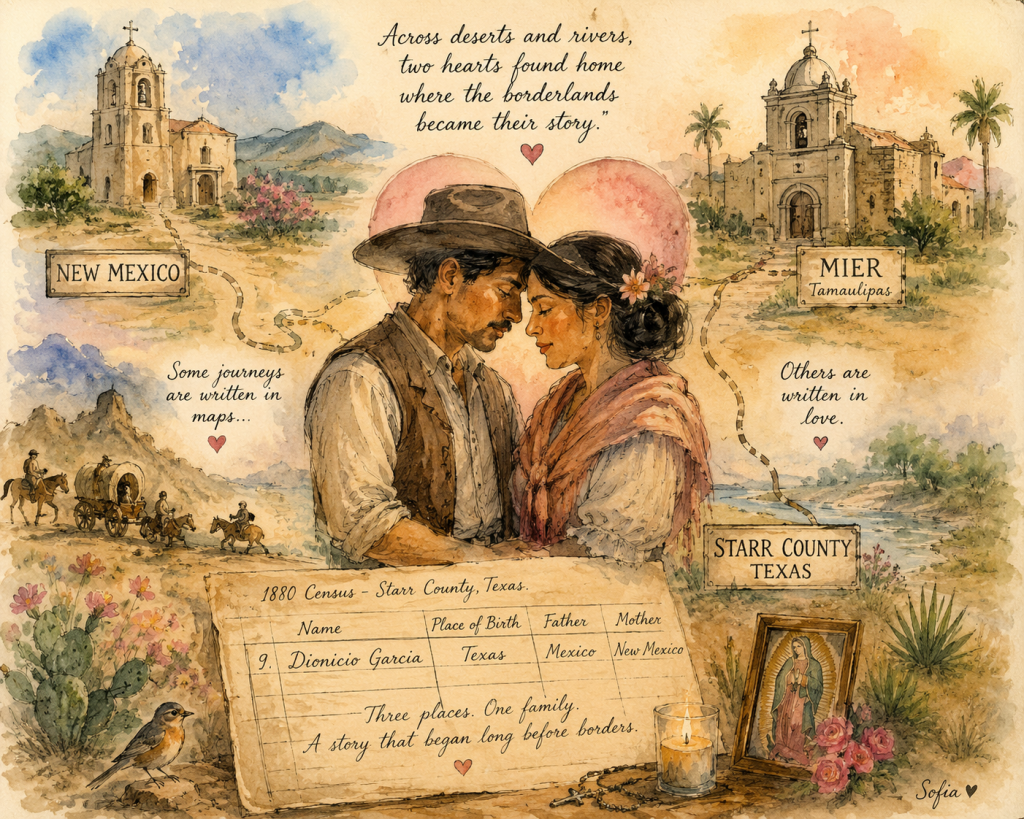
One of my cousins remembered members of the Guerra family who lived across the Río Grande coming to visit her parents. They would cross the river, spend the day visiting family and normally return home that same evening.
By then, of course, the Río Grande had long been an international border. But the habit of moving through that country was much older than the border itself.
Before 1848, the river did not separate Mexico from the United States there because the modern international boundary did not yet exist. Families were already living, ranching, and marrying along both banks.
When the political boundary changed, the people did not suddenly forget where their relatives lived.
José Santiago Barrera belonged to the founding generation
The more I follow José Santiago Barrera, the less he looks like a man who merely moved into an established town.
Mier itself had been founded only a few years before he appears in its early history. The official record places him in local government and militia leadership while the community was still developing its institutions. (tamaulipas.gob.mx)
That changes how I see the family tree.
When I look at a chart and see the name José Santiago Barrera, I am not simply looking at another ancestor born sometime in the eighteenth century. I am looking at someone who lived while Mier was still becoming a permanent settlement, when houses were scattered, cattle and sheep sustained the economy, local men provided much of the defense, and family alliances could mean the difference between surviving and failing on the frontier.
His descendants stayed tied to that same region.
José Cecilio Barrera Ramírez was born in Mier in 1797. His baptism and parents are recorded there. His marriage is tied to the same area, as are the births of his children. Both Barrera and Ramírez were old names in the communities around Mier.
That is one reason I remain skeptical of an unsourced family-tree claim that José Cecilio died in Ecatepec de Morelos, far to the south near Mexico City. I have searched for the evidence and have not found it. His documented life repeatedly returns to Mier and the Río Grande border country.
A person certainly could have traveled far from home late in life, but history requires more than a precise date typed into somebody else’s family tree. Until a record appears, I would rather say his place of death is unknown than create certainty where none exists.
These families were older than the border
The family names keep repeating: Barrera, Ramírez, Guerra, García, Chapa, Hinojosa.
That repetition tells us something. These were not isolated families passing through the region independently. They were part of a network of frontier communities stretching along the Río Grande and back toward older settlements such as Camargo and Cerralvo.
José de Escandón’s colonization program deliberately drew settlers from those older communities when Mier was founded in 1753. (tamaulipas.gob.mx)
Over generations, those settlers married one another, baptized one another’s children, witnessed marriages, shared ranching work and crossed the river to see relatives.
The border eventually changed around them.
Their family geography did not disappear.
That may help explain why nineteenth-century records can be confusing to modern genealogists. One census may identify someone as born in Texas, another as born in Mexico. A family may appear on one side of the river and later on the other.
We instinctively want to classify that as immigration.
Sometimes it was. But sometimes these people were moving inside a family world they had occupied long before anyone drew the modern international boundary through it.
They were there while Mier was becoming Mier
Mier today is remembered for later events, particularly the nineteenth-century conflicts between Mexico and Texas. But the town had already existed for nearly ninety years before the famous Mier Expedition arrived.
Its earlier history belonged to families.
They built houses from mud and stone. They raised livestock. They searched for water during dry years. They buried children and parents. They traveled armed when circumstances required it. They worshiped, married, fought, governed, and depended upon neighbors whose descendants would continue appearing in the same records for generations.
Some of those people were my ancestors.
When Mier was founded in 1753, it was a small and uncertain experiment on the northern frontier of New Spain. Within a generation, José Santiago Barrera was serving there as a militia officer and local official. His descendants remained connected to Mier and the Río Grande country long afterward.
The Barreras did not arrive after Mier’s history had already been written.
They helped live the first chapters of it.