For years, Black and Mexican-American children attended West Oso schools under a system controlled largely by Anglo trustees. The district segregated Black students, Mexican-American families had little political power, and many of their children were steered toward trades rather than college. Yet there was no comparable public campaign by the Texas Education Agency declaring that West Oso was so badly run that it should lose accreditation.
Then Molina learned how to vote its numbers.
1963: Molina changed who controlled the schools
In 1963, Mexican-American voters, most of them living in Molina, elected a majority to the West Oso school board for the first time. The change was dramatic enough that two Anglo trustees resigned in protest. In their resignation statement, they complained that the board was being dominated by the Molina Civic Association.
That newspaper article is important because it tells us exactly what had changed. West Oso did not suddenly acquire Mexican-American and Black children in 1963. They had been there all along. What changed was that the people whose children filled the schools finally gained control of the board that governed them.
Board president Amador Gutierrez responded to the resignations by appointing two Anglo residents to the vacant seats. His explanation was revealing: he said the new board now represented all sections of the West Oso district.
The new majority did not simply reverse the discrimination and exclude Anglos. It tried to build a board that represented the district’s population.
Soon afterward, West Oso began doing things the old system had resisted. Black teachers were integrated into previously white faculties. Attendance boundaries were changed. Black residents gained representation on the school board. Plans moved forward for a new high school nearer Molina.
Then the state began telling West Oso it was failing.
In 1965, TEA suddenly discovered a problem
Years later, when more than 200 angry parents packed West Oso High School to confront the Texas Education Agency over accreditation, TEA official H. F. Phillips told them something important.
He said the agency had been warning West Oso since 1965 that it had to improve or risk losing accreditation.
The date matters.
Only two years earlier, control of West Oso had passed from the old Anglo establishment to a Mexican-American majority elected largely from Molina. Within another year, the district had integrated Black teachers. Then, in 1965, the state began the accreditation pressure that would continue for years.
That chronology does not disappear simply because TEA could point to deficiencies in the district. West Oso certainly had problems. It was a poor district serving children whose families had been neglected for generations. The question is why those problems became an accreditation crisis after the people governing the district changed.
The parents at that meeting apparently understood that there was something larger happening.
The state told them they needed more vocational education
The newspaper account of the accreditation meeting is revealing because the parents were not merely defending their school. They challenged what the state believed their children should become.
Phillips said West Oso needed more vocational education. He complained about student behavior and school pride and talked about such things as writing on walls, plumbing, and keeping restrooms clean.
Dr. Clotilde García, a Corpus Christi physician and the sister of American G.I. Forum founder Dr. Héctor P. García, confronted him.
Her response went directly to the history of Mexican-American and Black education. She argued that those students had already been channeled into trades for too long. She told Phillips that what West Oso children needed was to be taught to read, write, think, and live in the modern world.
Then a young woman in the audience supplied the evidence.
She complained that counselors did not tell students about all of the opportunities available to them. Instead, she said, they would automatically send them toward Del Mar Tech.
Phillips answered that this was precisely the kind of thing his accreditation team had observed.
That exchange is remarkable. TEA was criticizing West Oso’s educational system while simultaneously recommending more emphasis on the vocational path that Mexican-American parents believed had been used for years to restrict their children’s ambitions.
The parents were not opposed to trades. They were opposed to somebody else deciding that trades were where their children belonged.
Genaro Bernal shows what they meant
I knew one of those students.
In 1967, my friend Genaro Bernal graduated as West Oso High School’s valedictorian with a 93.35 average.
Read his record in the newspaper.
He was president of the Student Council. He had been president of the Science Club and Math Club. He had been president of his freshman class. He participated in the school’s tutoring program. His interests were mathematics and science.
And the newspaper reported what Genaro wanted to become:
an engineer or a teacher.
If any student at West Oso should have been encouraged toward a four-year university and engineering school, it was the valedictorian who had led the Science and Math clubs.
Yet the path available to Genaro led toward Del Mar. I remember that he received a scholarship of only about $100. He went into technical schooling and eventually dropped out.
I cannot tell from the newspaper where Genaro’s idea of becoming an engineer originated. I can tell you that I knew him, and I know where his education ultimately took him.
His story makes Dr. García’s objection much easier to understand.
When she said Mexican-American and Black students had been channeled into trades for too long, she was not discussing some theoretical educational philosophy. Children like Genaro were sitting in West Oso classrooms.
Three years later, look at the valedictorian
Now move forward only three years.
The 1970 West Oso valedictorian was Jonas Salinas Jr.
Salinas received a $6,000 James R. Hoffa Scholarship Foundation grant to attend the University of Texas at Austin, where he intended to study pre-law. He had been in West Oso schools for twelve years, served as president of the Student Council, and was parliamentarian of the All-City Student Council.
The salutatorian, María de la Luz Martínez, was already participating in Upward Bound at Texas A&I University. She attended special summer classes and other university activities and was considering studying English and becoming a teacher.
Compare those students with Genaro Bernal only three years earlier.
In 1967, West Oso’s valedictorian talked about becoming an engineer and went toward technical education with a tiny scholarship.
In 1970, West Oso’s valedictorian was headed for the University of Texas with $6,000 and plans for pre-law, while the salutatorian was already being introduced to university life through Upward Bound.
The children had not suddenly become smarter.
The expectations surrounding them had changed.
Molina and West Oso answered the state
That may be the greatest irony in the accreditation fight.
After Mexican-Americans gained control of the West Oso school board, the state essentially told them that they were not doing a good enough job educating their children. Among the remedies offered was greater emphasis on vocational education.
Molina parents answered that they had already seen where that road led.
Their children had spent generations being told, directly or indirectly, that other people’s children became doctors, lawyers, and engineers while theirs learned a trade. The parents who confronted TEA were demanding something different. They wanted their children given the education and information necessary to choose for themselves.
West Oso’s later graduates began proving what those parents already believed.
They won scholarships. They entered universities. They participated in Upward Bound. They studied law, education, and other professions. The district that TEA threatened with loss of accreditation produced young people capable of succeeding wherever somebody finally opened the door.
None of this means West Oso had no educational problems. A poor district serving a neglected population could certainly have inadequate programs, weak counseling, and shortages of resources. But those shortcomings did not begin when Mexican-Americans took over the school board.
Poverty had been there.
Black children had been there.
Mexican-American children had been there.
What changed in 1963 was who had political power.
For years, the people of Molina had watched others decide what kind of education their children needed and what kind of future was appropriate for them. In 1963, they finally gained enough votes to make some of those decisions themselves.
Two years later, the state began threatening their accreditation.
And when state officials suggested steering still more of their children toward vocational education, Molina parents pushed back. Dr. Clotilde García gave their objection words: Black and Mexican-American children had been channeled into trades long enough.
They deserved to be taught to read, write, and think.
They deserved to decide what they would become.
And the generations of West Oso students who followed helped prove that their parents were right.
_________
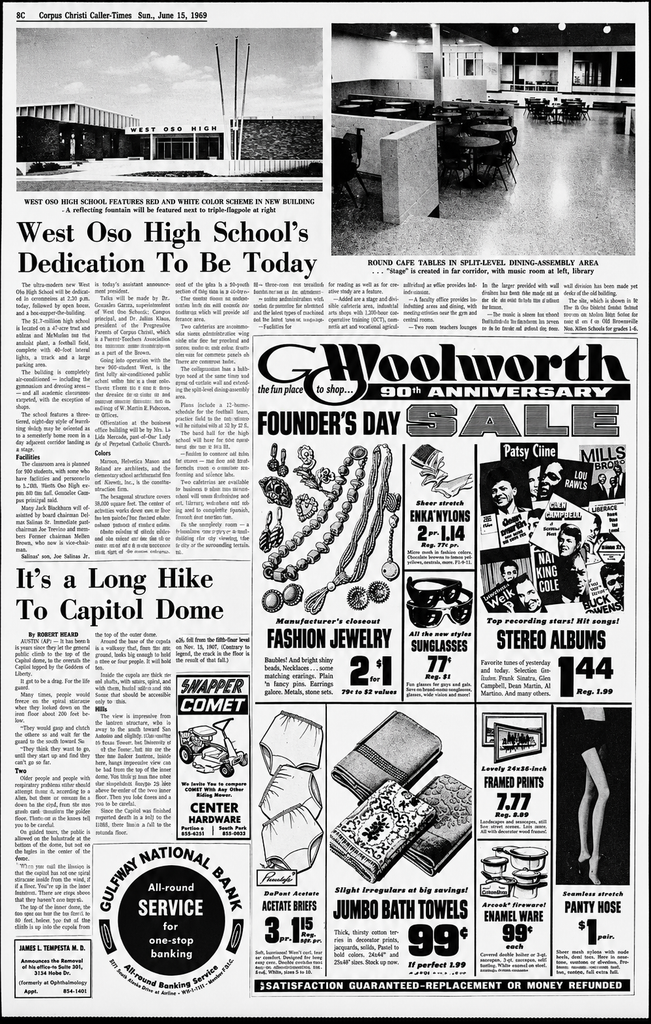
The new West Oso High School was being formally dedicated that day. The school cost about $1.7 million. It was described as an ultra-modern building with an academic plan organized around courtyards and specialized areas. The building included:
- 87 classrooms
- science facilities
- homemaking and business areas
- language labs
- music rooms
- a library
- administrative offices
- teacher lounges
- vocational/agricultural training areas
The article describes a split-level dining/assembly area, shown in the upper-right photo, with round café tables and spaces connected to the library and music areas. It mentions a red-and-white color scheme throughout the new school. There was a reflecting fountain near the entrance, visible in the photograph. The school was designed to serve roughly 900 students, with some rooms capable of being combined or opened for larger groups. The architects were May Jack Blackham and associated firms, with contractors and subcontractors listed in the article. The dedication included school officials, board members, and community figures.