I used to go to Zapata to visit relatives. Later, I drove across Falcon Dam on my way into Mexico, with the Rio Grande held back on one side and the road carrying me over the border. The dam was finished before I was old enough to remember its construction. It was simply there, a great long wall across the river and a lake where a river had once run.
I knew a Mexican town had been moved to make room for that lake. What I did not know, until I read the newspapers from the dam’s first years, was that a Texas town had been moved too. The Zapata I visited was the new Zapata. The old county seat lay beneath the water.
A lake in the brush country
Imagine approaching the Rio Grande in the early 1950s. For miles there were ranch roads, dry hills, thorny brush and the river, narrow enough in places to make the scale of the country hard to believe. There were no big inland lakes nearby to draw weekend crowds. Then, behind the new dam, water spread into the valleys and creek beds until it made a broad reservoir where people could bring a boat, cast a line or simply stand on the bank and stare.
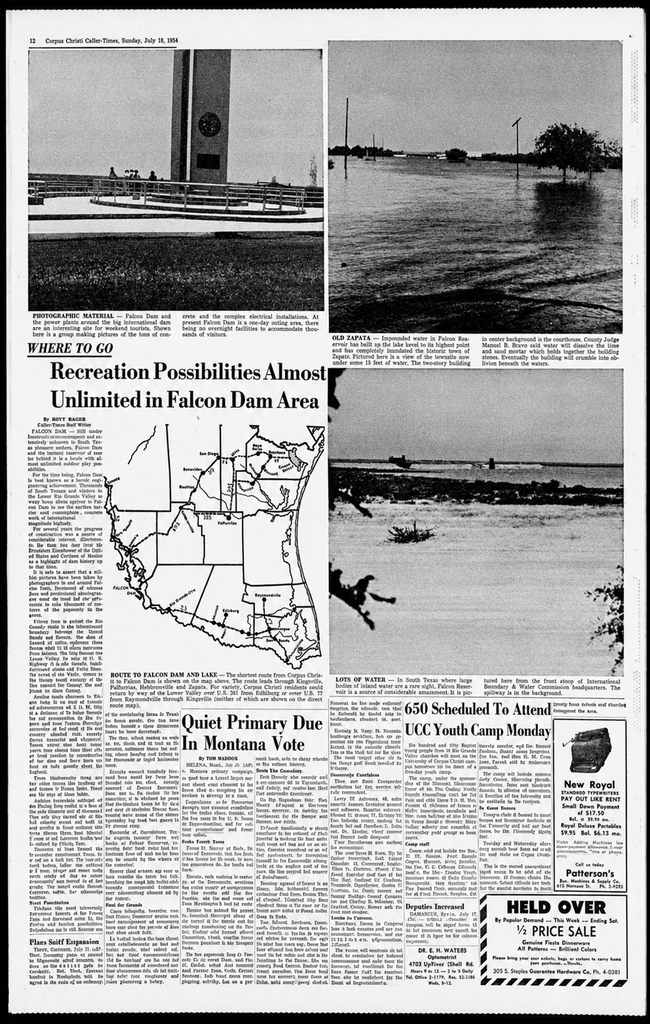
The newspapers knew what a sight that would be. A 1954 Corpus Christi Caller-Times story called large inland bodies of water rare in South Texas and imagined what Falcon Lake could become: fishing, sailing, motorboating, boat rentals, bait stands and visitors driving in from the Valley, Laredo and beyond. Bass had been stocked. The shore, with its coves and flooded brush, seemed to offer more places to fish than anybody could explore in a single trip.
I can understand the excitement. A person could take the family out to see an enormous new lake in a country accustomed to measuring water carefully. Fishermen would soon have stories to tell, whether or not the fish cooperated. For people who lived inland, a day on a boat no longer meant a long trip to the coast. The promise of recreation was real, and so was the pleasure of seeing all that water against the South Texas hills.
What it took to fill it
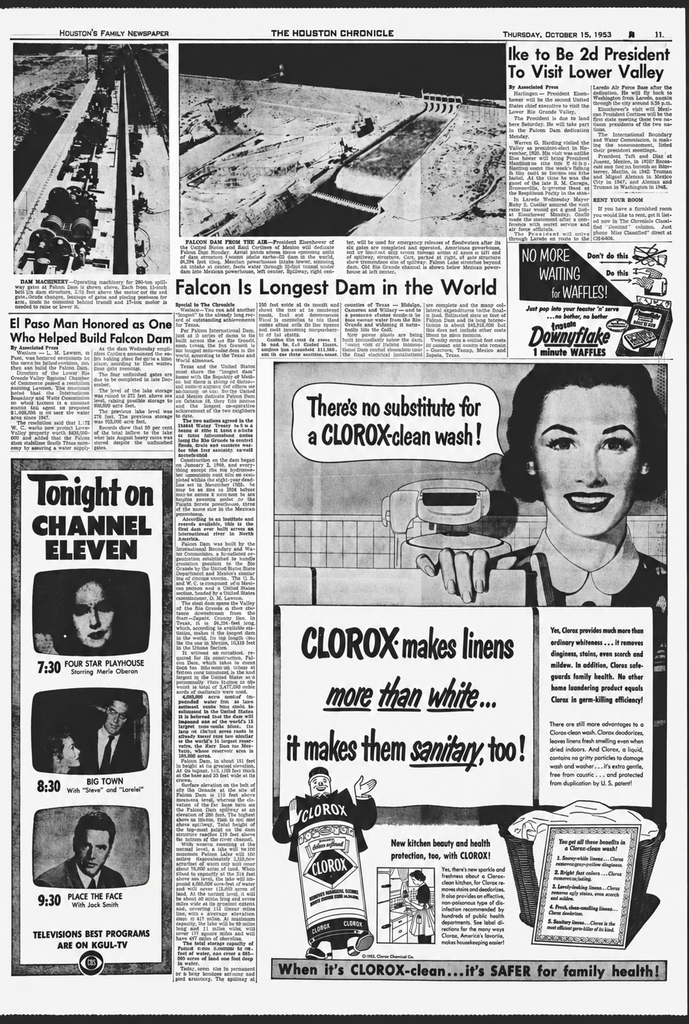
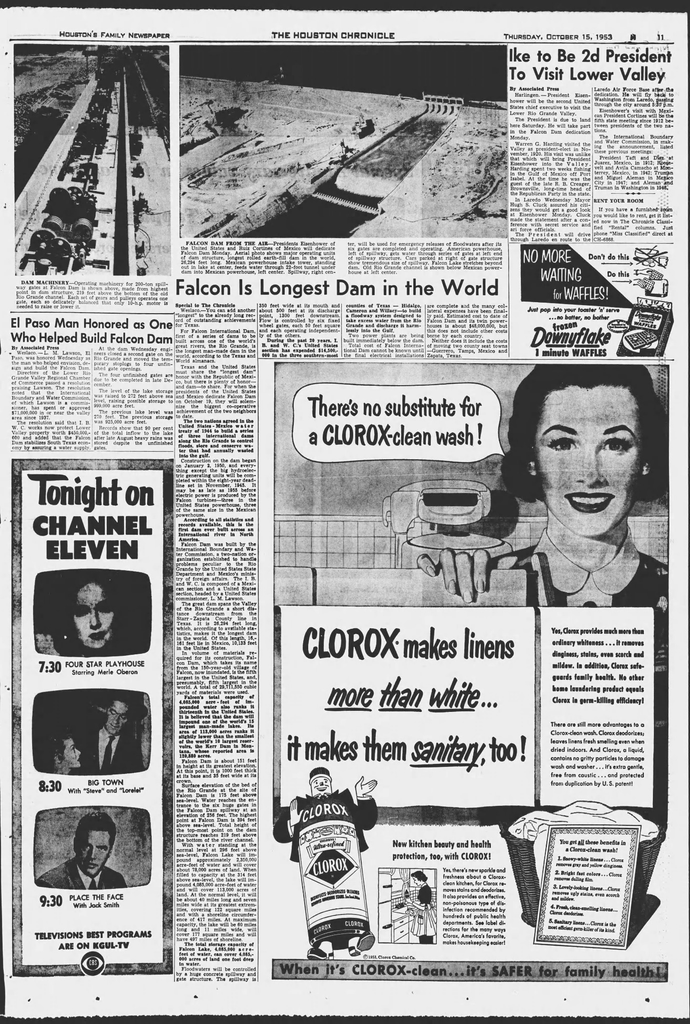
The dam had a purpose beyond the weekend. The United States and Mexico agreed under their 1944 water treaty to build works that would store river water, help control floods and produce power. Construction of Falcon Dam began in 1950, and Presidents Dwight Eisenhower and Adolfo Ruiz Cortines dedicated it in October 1953. Its earthwork ran for miles across the borderland; the road across its top joined the two countries at the river.
In the news photographs, the project looks immense. Men, trucks and machinery appear small beside the spillway and the long slopes of earth. The headlines celebrate engineering and cooperation, and understandably so: here were two countries building something together that would change the river and the lives depending on it.
Those same newspaper pages tell a second story. The water could rise only because people moved out of its way. Falcon Lake covered the sites of Old Zapata in Texas and Old Guerrero in Tamaulipas. Homes, streets and the familiar locations of daily life had to be given up so the reservoir could hold water for farms and towns downstream.
The Zapata beneath the lake
Old Zapata had stood beside the Rio Grande for generations. Its replacement was built on higher ground several miles away, with a new courthouse, schools and public services. On a map the move looks short. For someone whose family had lived by the old streets, it was the distance between a place you knew by heart and a place you had to learn to call home.
The 1954 Caller-Times carried a photograph that stopped me. Its caption said the old townsite lay under about fifteen feet of water. The two-story courthouse could still be seen in the background of the picture. Zapata County Judge Manuel B. Bravo told the paper that the water would wear away the lime-and-sand mortar between its stones and that the building would eventually crumble. It is one thing to say a town was relocated. It is another to look at its courthouse standing in the lake and understand that there was no going back to the old one.
Across the river, Guerrero had its own move to make. The Mexican government built Ciudad Nuevo Guerrero above the new water, with a plaza, a municipal building, roads, lights and water services. The Valley Evening Monitor reported that residents resisted a plan that would have placed them under a neighboring municipality; the boundaries were adjusted so Guerrero could keep its own civic identity. They were losing the site of their town. They did not intend to lose the town itself.
A shoreline with two histories
The recreation writer in 1954 saw the lake as an invitation. His article described routes for travelers and the attractions that might grow around the shore, while a photograph on the same page showed Old Zapata disappearing under the reservoir. I keep returning to that newspaper page. The promise and the loss were printed side by side, close enough for any reader to see.
That is how I think of Falcon Lake now. I can picture a family packing fishing rods for a Sunday trip, a boat moving into a quiet cove, children seeing a great sweep of water where their parents remembered brush and riverbank. I can also picture someone pointing across that same water and saying, “Our courthouse was over there.” Both people would be telling the truth about the place in front of them.
When I visited people in Zapata, I was visiting the town that had been rebuilt. When I crossed the dam into Mexico years later, I traveled over the structure that had made the lake and changed the location of two communities. I did not need to know that history to make the drive. Now that I do know it, I cannot look at the reservoir as scenery alone. There is water for the fisherman, a road for the traveler and, beneath the surface, the ground where Old Zapata and Old Guerrero once stood.
.
.
.