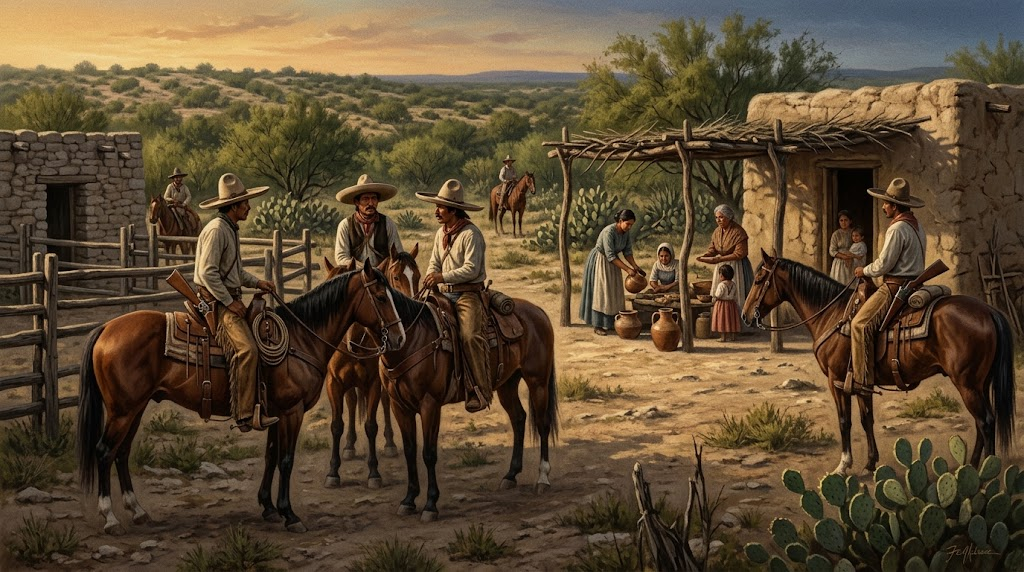
The riders gathered before the dust had even begun to drift across the Arroyo de los Guerras. It was the low, breathless hour before sunrise, when the chaparral looked gray as lead and the cold damp off the river clung to wool and sheepskin. Nobody had sent a courier with a written dispatch, and no bells had been rung from the mission steeple down in Roma. A single gunshot fired three times in rhythm off the bluff at Fronton was all it took. By the time the third echo died in the cane brakes, horses were being caught in the dark, cinches were pulled tight with boots braced against ribs, and the Winchester rifles were slid into worn saddle scabbards.
At the cedar rail gate stood Aniceto, tall and straight-backed in the gloom, watching the men filter in out of the scrub in pairs and threes. They looked enough alike to have been cut from the same bolt of cloth: long in the leg, high-bridged in the nose, with the pale, sun-bitten eyes of northern men whose grandfathers had ridden up through Cerralvo when the world was still empty. Alejandro pulled his mount up beside his brother, touching his hat brim with two fingers, while behind him came the younger Garcias and two cousins whose names were known on every brand registry between Camargo and the Nueces. Out here, a uniform meant nothing and a badge meant even less; what counted was the blood that tied the man on your left to the woman baking bread in your kitchen.
Word had come down from the north that a patrol of Rangers was working the brush, trailing stolen stock they claimed had crossed the river, though everyone knew they rarely bothered to ask whose brand was on the hip before they began setting fire to brush arbors and claiming the horses. Farther west, out in the open flats toward Zapata, a band of Lipan raiders had been spotted watering their ponies under the full moon two nights back. To an outsider or an officer sitting behind a desk in Austin, the border country looked like sheer lawlessness, a howling wasteland where life was cheap and discarded easily. But to the men sitting on those horses, the law was absolute, ancient, and unbreakable: it lived in the ribbon of land deeded to their great-grandfathers by the Spanish crown, and it was defended by a kinship network so tight that a threat to one rancho was an assault on ten leagues of family.
“They’re tracking the high ridge toward Los Guerras,” Alejandro said, his voice flat and low above the nervous shifting of the horses’ hooves. “Six riders, maybe seven. Moving fast.”
Aniceto didn’t answer right away. He reached down and adjusted the rawhide loop of his reins, looking past the corral toward the jacal where the women were already moving in the dim yellow glow of a tallow candle. Inside, Santos was already up, minding the younger ones, while water boiled over mesquite embers and dry provisions were packed into saddlebags just in case the brush became their home for three days. There was no fear in that house, only the practiced, quiet efficiency of people who had outlived three wars, two revolutions, and the cholera by never looking beyond the family for salvation.
“We don’t meet them in the clear,” Aniceto said, turning his gelding toward the dense thicket of blackbrush and catclaw where a stranger’s horse couldn’t take three strides without breaking its stride. “Let them come into the thorn. Tell the boys at the lower crossing to close the gap behind them. If they want to talk, they talk to the whole river.”
He nudged the horse forward with his spurs, and forty men followed him without a shout or a bugle, melting into the gray mesquite until the brush swallowed them whole, leaving behind only the clicking of longhorns in the distance and the silent, enduring land that belonged to none of the flags that tried to claim it.