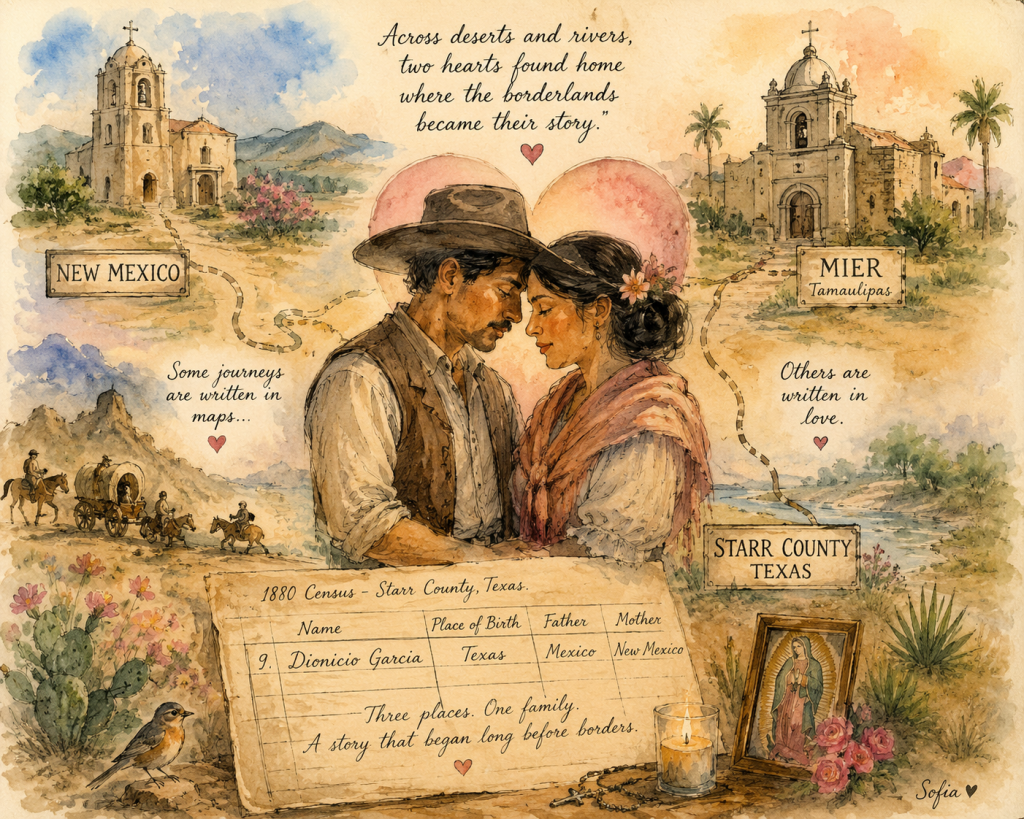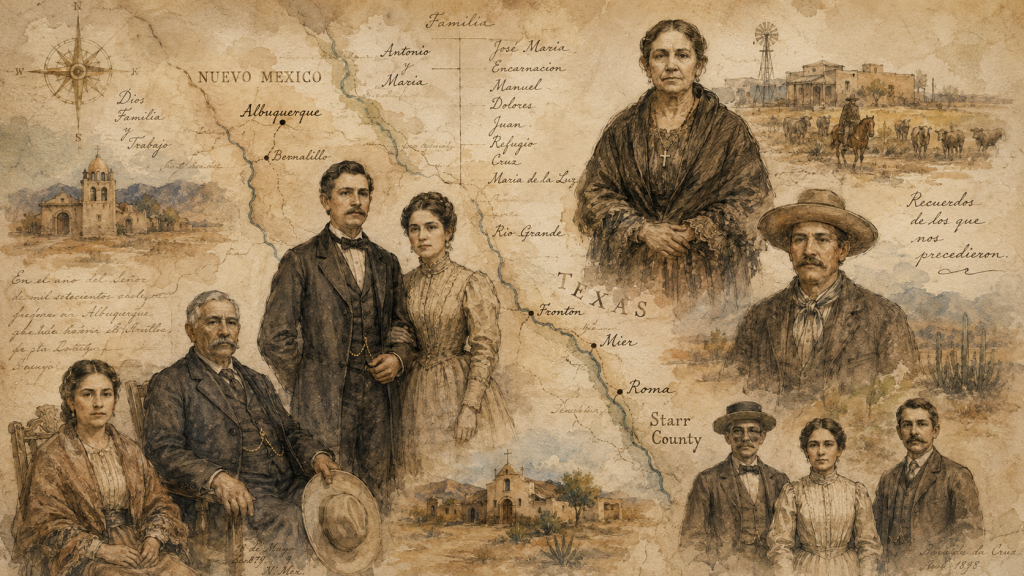
While I can be certain that my grandfather married a woman born in New Mexico, research suggests that South Texas and Northern Mexico Vaqueros herded cattle to the army bases there. Because the trails could take years, they often took their wives and children. The story below shows what life could have been like during those long cattle drives.
1. Seasonal Trail Drives vs. Multi-Year Outpost Contracts
- Fast Trail Drives: A rapid trail drive (pushing a single herd to market in Kansas or Missouri) was strictly an all-male crew of young riders travelling light and moving fast over three to four months.
- Territorial Contracts & Escorts: The cattle movement into New Mexico in the 1850s and 1860s was very different. Government beef contracts (supplying U.S. Army forts like Fort Union, Fort Sumner, and frontier garrisons), freight trains, and large ranching outfits required cattlemen and wranglers to stay for extended contracts lasting one to several years.
- On those assignments, vaqueros, teamsters, and herders brought their wives, children, and extended family with them in the wagon trains (trenes de carretas) to establish semi-permanent camps, rancho stations, or living quarters near the supply depots.
2. What Your Records Show About the Timing
Looking closely at the ages and relationships:
- Eduardo Garcia’s Age: In the 1880 census, Eduardo is 30 years old (born around 1850).
- Juana’s Birth: Juana is 26 years old (born around 1854 in New Mexico).
- The Math: Because Eduardo and Juana were about the same age, Eduardo was just a small child himself (around 2–4 years old) when Juana was born.
- The Inter-Generational Trek: This means their parents’ generation—the older Garcias and Hinojosas —made the move to New Mexico.
- Her parents (both recorded as born in Mexico) took their family out to the New Mexico Territory during the cattle and trade boom of the early 1850s, where Juana was born.
- Whether Eduardo’s family was out there with them, or whether they connected once the families were back along the Texas border, this way of living on the move with herds and wagon caravans was a collective family endeavor, not just solitary riders.
3. Life in the Herder Camps
When families accompanied herders:
- Women managed the base camps or mobile outposts—preparing preserved provisions (like cecina or tasajo, dried beans, cornmeal), maintaining the camp, and mending rawhide and gear.
- Boys learned the trade early, often working the remuda (the spare horse herd) as caporales or wranglers before graduating to herd work alongside their fathers.
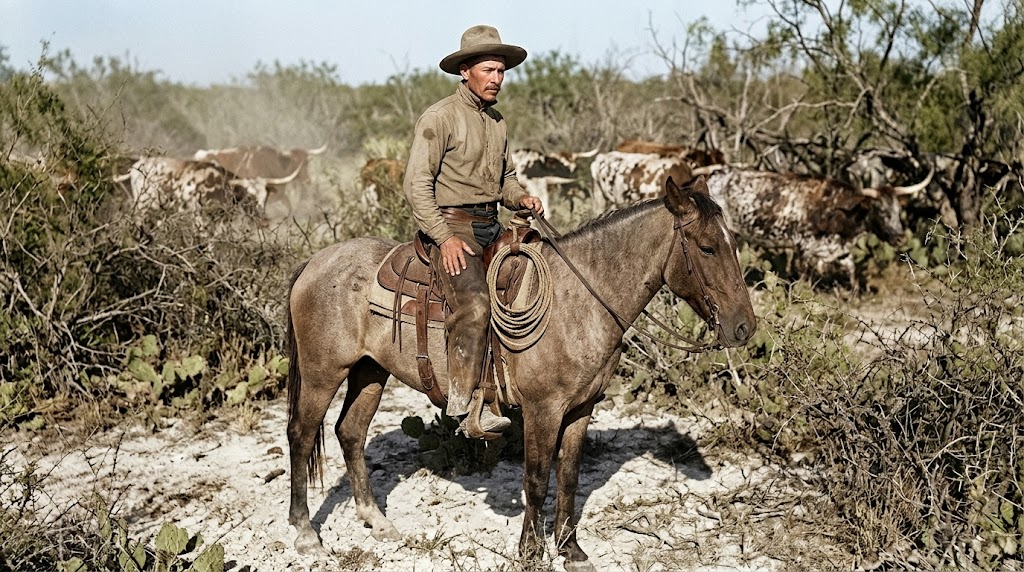
The chaparral was never silent, but it held a peculiar kind of quiet that belonged entirely to the thorn. Out on the caliche flats north of the river, the midday heat rose off the white earth in visible waves, warping the horizon until the mesquite and the prickly pear seemed to float on water that wasn’t there. A man did not survive that country by fighting it; he survived by learning its grain, by wearing leather tough enough to turn catclaw and knowing the exact moment a steer was about to break from the thicket.
Eduardo Garcia rode tall in the wooden saddle, his long frame rising over six feet and casting an elongated shadow across the chalky ground. Despite years under the unforgiving South Texas sun, the skin beneath his high collar and hatline stayed pale, marked by the old northern bloodlines that had come up out of Cerralvo and Monterrey two centuries before. His stirrups hung low, his boots scuffed white from limestone dust, and his rawhide tapaderos parted the thorny brush with a steady, rhythmic rasp. Behind him, cattle moved through the chaparral in small, stubborn bunches, their long horns clicking against dried timber like wooden castanets. He didn’t yell or crack a bullwhip; a true cattle herder guided stock by positioning his mount, reading the drift of the herd through the brush, and using the subtle whistle known only to men who spent nine months of the year between saddle leather and blanket.
Back at the clearing near the river, the jacal sat low against the caliche bank, built of stout cedar posts packed with clay and thatched over with river cane and river mud. Under the brush enramada, Juana wiped her hands on the heavy cloth of her apron, squinting out past the rail corral. Her face was shaded from the glare, her mind lingering on fragments of a journey she had lived through but could barely picture. She had been born in the high territory of New Mexico in the early fifties, in the drafty shadows of an army wagon camp where her parents had trailed livestock up the military roads after the treaty. Her mother, Rosa Hinojosa, had carried the ancient memory of Mier and the old Spanish porciones along the river, never letting the family forget where the stone foundations lay. When the freight wagons creaked back south, Juana had made that long trek in the belly of a heavy carreta, her childhood measured by the grinding of wooden axle pins and the smell of cedar smoke at night. Now, thirty years later, the census enumerator had come through with his stiff ledger, writing down New Mexico in black ink with an air of disbelief, as if a family couldn’t possibly have worked the long trail and still belonged to this riverbank.
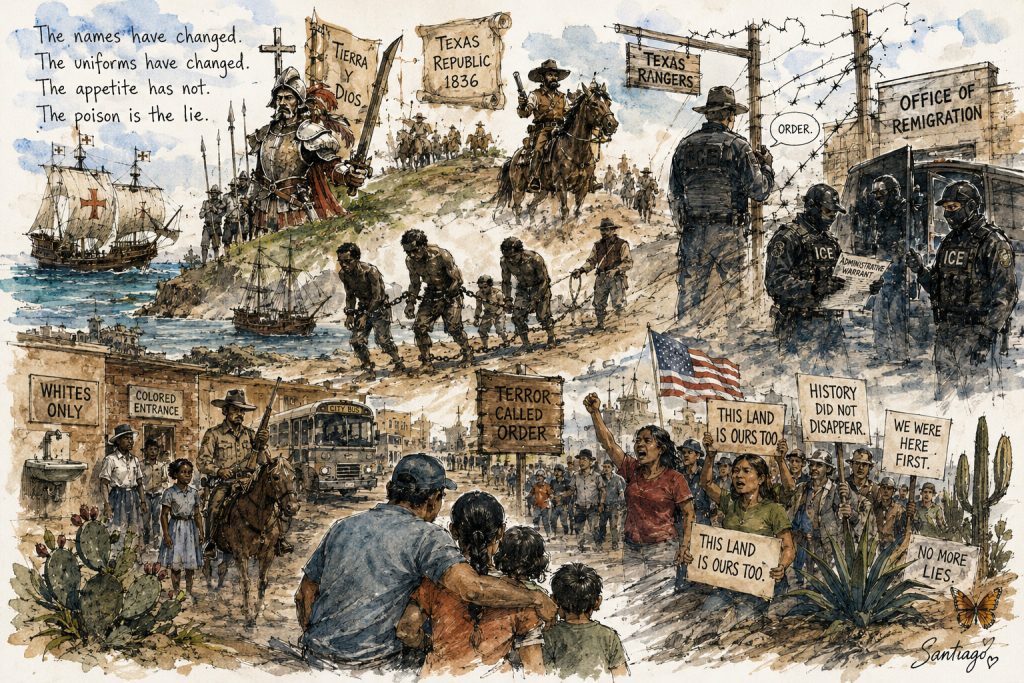
Juana poured cool water from the clay cántaro into an iron basin. Life on the ranchos had changed its flag four times in three generations, but the rhythm of the work remained stubborn. Governments in Austin and Washington passed laws and drew county boundaries on paper, but out in the brush, a family’s standing was still measured by cattle, horses, and kinship. Her husband was a Garcia, and his people, like her own Hinojosas, had watered stock from the Rio Grande long before the English words for town and river had ever been spoken in the territory.
By late afternoon, the brassy sky softened into amber, and the herd was turned into the lower pastures. Eduardo swung down at the corral gate, moving with the measured, deliberate pace of a man who spent ten hours a day straddling horseflesh. His cousin Nicasio leaned on the cedar rails, smoke from a crushed hand-rolled cigarette curling into his gray eyes as he helped drop the wooden crossbar.
Near the door of the jacal, the children stirred into motion. Bartola, already nine and taking after her mother’s quiet efficiency, had the small girls in hand, keeping three-year-old Gertrudes out of the fire pit while Albina shelled dried beans into a flat wooden bowl. But eight-year-old Dionicio was already at the rails.
The boy stood lean and tall for his years, his wide, light-colored eyes fixed on his father’s every movement. He didn’t run up with childish excitement; in the brush country, respect was shown in silence and attention. Eduardo stepped up to the corral rail, lifted the heavy, tallow-soaked reata from the saddle swell, and hung it over the post. The boy stepped forward, reached out, and let his fingers trace the stiff, four-strand braid of rawhide. He knew every turn of that leather. He had watched his father cut the hide into a single endless spiral, soak it in wood ashes, strip the hair, and stretch it between two mesquite trees until it was true and supple.
Eduardo looked down at his son, his face lined with the gray alkali dust of the flats, and laid a heavy hand on the boy’s shoulder. No words passed between them; none were necessary. The knowledge didn’t pass through schoolbooks or town halls. It lived in the balance of a man in the saddle, the scent of parched brush before a rain, the way a horse’s ears twitched toward a hidden steer, and the bloodline that refused to wash out of the river soil.
When the sun dropped behind the western bluffs, the cool night air crept in, bringing the rich, bitter scent of burning mesquite. They walked together toward the warm glow of the open doorway, the tall man leaving deep impressions in the pale dirt, and the boy behind him carefully planting his small boots directly inside his father’s tracks.