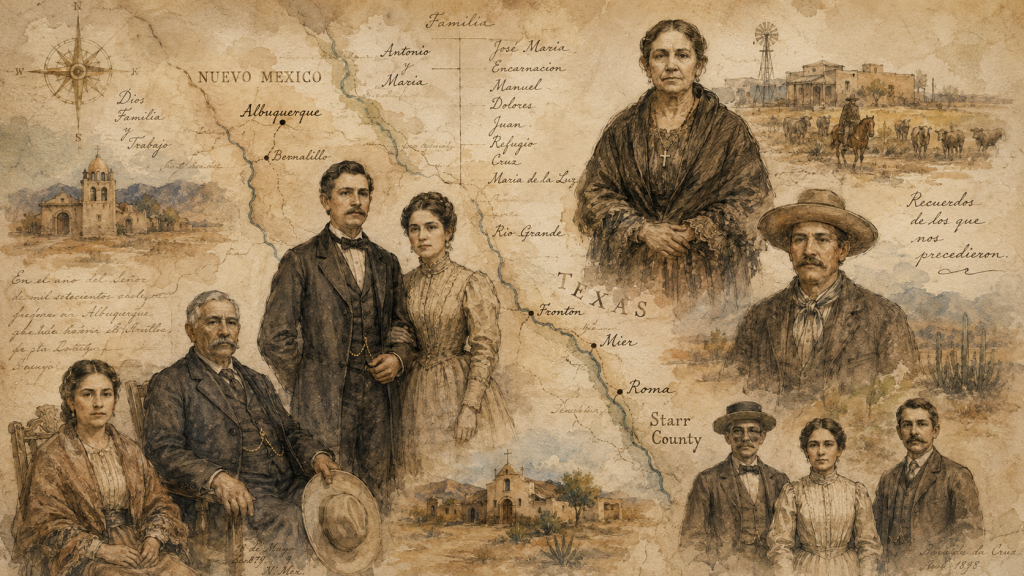
For those searching for ancestors. I have spent about 15 years researching ancestors; information is hard to find. So I hope this helps a few of you. But if nothing else, you can find out who first settled and established Laredo, Texas.
.
Laredo in 1757: The Families Behind the Census
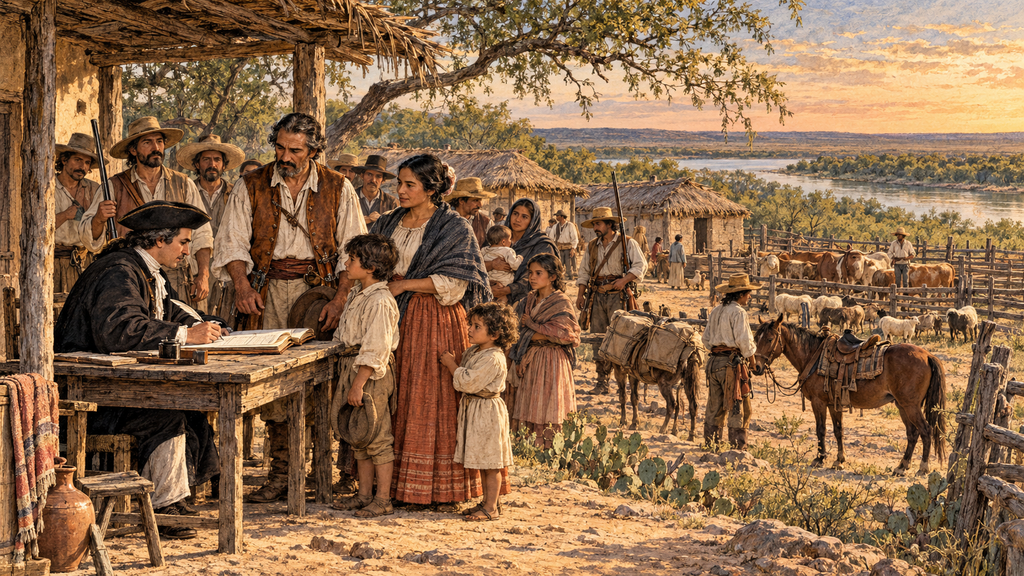
Before the Rio Grande became an international boundary, Laredo was a small settlement in the Spanish colony of Nuevo Santander. Its 1757 census records families, children, servants, weapons, and livestock. The first entry belongs to Capitán don Tomás Sánchez and his wife, doña Catarina de Uribe.
José Tienda de Cuervo conducted the revista on July 23, 1757. The closing statement reports 11 families and 85 people. The list contains 15 separate entries; its historical “Familias” column should not be treated as a modern count of households.
The Household and Livestock List
Below is the Spanish transcription provided by UNAM’s Poblar el Septentrión project, reformatted for easier reading. Names and figures follow that transcription. Line-break marks have been removed, and Tomás Sánchez’s entry, which crosses two manuscript pages, has been joined.
Blank cells mean no figure is entered in that column; they do not necessarily mean zero. “Bestias caballares” is the equine-stock column, “mulas aparejadas” refers to equipped or pack mules, “yuntas” to pairs of draft animals, “ganado menor” to small livestock, and “ganado vacuno” to cattle. Horses mentioned in the written descriptions are kept separate from the numeric equine-stock column.
| Familias | Vecinos y familias | Personas | Bestias caballares | Mulas aparejadas | Yuntas | Ganado menor | Ganado vacuno |
|---|---|---|---|---|---|---|---|
| 1 | Capitán don Tomás Sánchez, casado con doña Catarina de Uribe, nueve hijos, 70 caballos, 10 burros, 20 burras, todas armas, siete sirvientes, el uno casado y tiene una hija. | 20 | 500 | 125 | 2 | 2000 | 50 |
| 1 | Don Juan García Zaldívar, casado con doña Catarina de las Casas, todas armas, cinco caballos, dos sirvientes. | 4 | 250 | ||||
| 1 | Don Prudencio García, casado con doña Josefa Sánchez, cinco hijos, todas armas, 10 caballos. | 7 | 1400 | ||||
| 1 | Don José Leonardo Treviño, casado con doña Ana Moreno, seis hijos, todas armas, 12 caballos. | 8 | 60 | 1000 | 10 | ||
| 1 | Juan Francisco García, casado con María Rita, siete hijos, todas armas, seis caballos. | 9 | 25 | 600 | |||
| 1 | Don Juan Bautista Sánchez, casado con doña Juana Díaz, 10 hijos, todas armas, dos caballos. | 12 | 500 | 4 | |||
| 1 | Don Agustín Sánchez, casado con doña Francisca Rodríguez, dos hijos, todas armas y dos caballos | 4 | 100 | ||||
| 1 | Leonardo Sánchez, soltero, todas armas, 10 caballos, un burro, un sirviente. | 2 | 27 | 500 | |||
| 1 | Don José Flores, casado, tres hijos, todas armas, 15 caballos, y dos burros. | 5 | 30 | 1400 | 1 | ||
| José Díaz, soltero, tiene consigo a su madre, todas armas, seis caballos. | 2 | 130 | 29 | ||||
| 1 | José Ramón, ausente con licencia, casado con doña María Gertrudis, dos hijos, todas armas, seis caballos, dos burros. | 4 | 30 | 200 | |||
| 9 | Total acumulado — folio 284v | 77 | 660 | 125 | 2 | 8080 | 94 |
| Leonardo García, soltero, todas armas, cuatro caballos. | 1 | 25 | 400 | ||||
| 1 | Don José Salinas, casado con Isabel Treviño, un hijo, todas armas, dos caballos. | 3 | 15 | 400 | 3 | ||
| 1 | Pedro Salinas, soltero, tiene consigo a su madre y [a] una hermana, todas armas, ocho caballos. | 3 | 200 | ||||
| Juan Diego, soltero, todas armas, cuatro caballos. | 1 | 12 | 4 | ||||
| 11 | Total declarado — folio 285f | 85 | 712 | 125 | 2 | 9080 | 101 |
A note on the figures: The totals are reproduced as reported, rather than recalculated. The individual “Bestias caballares” entries add to 724, while the final total is 712; the marked “Familias” cells also do not match the reported total of 11. The people column adds to 85. These differences are left visible so readers can examine the original pages.
The Closing Statement
The inspector reported 712 breeding equines, 125 mules, two yuntas, 9,080 head of small livestock, and 101 cattle. His closing statement also lists 15 female donkeys, 16 male donkeys, and 162 horses used for service. Those last categories are not separate columns in the table.
The donkey figures in the closing statement also differ from those described in individual entries. They are preserved here as the record reports them.
Read the Original Manuscript
Open each section to see the manuscript image. Each link also leads to UNAM’s page with the original and its Spanish transcription.
Folio 284f: The opening of the census and the beginning of Tomás Sánchez’s entry
View folio 284f and its transcription at UNAM

Folio 284v: The household list and its cumulative totals
View folio 284v and its transcription at UNAM

Folio 285f: The final entries, totals, and closing statement
View folio 285f and its transcription at UNAM

Laredo, 1757: an imagined reconstruction of families gathering for the census beside the Rio Grande.