1598 – the founding of New Mexico
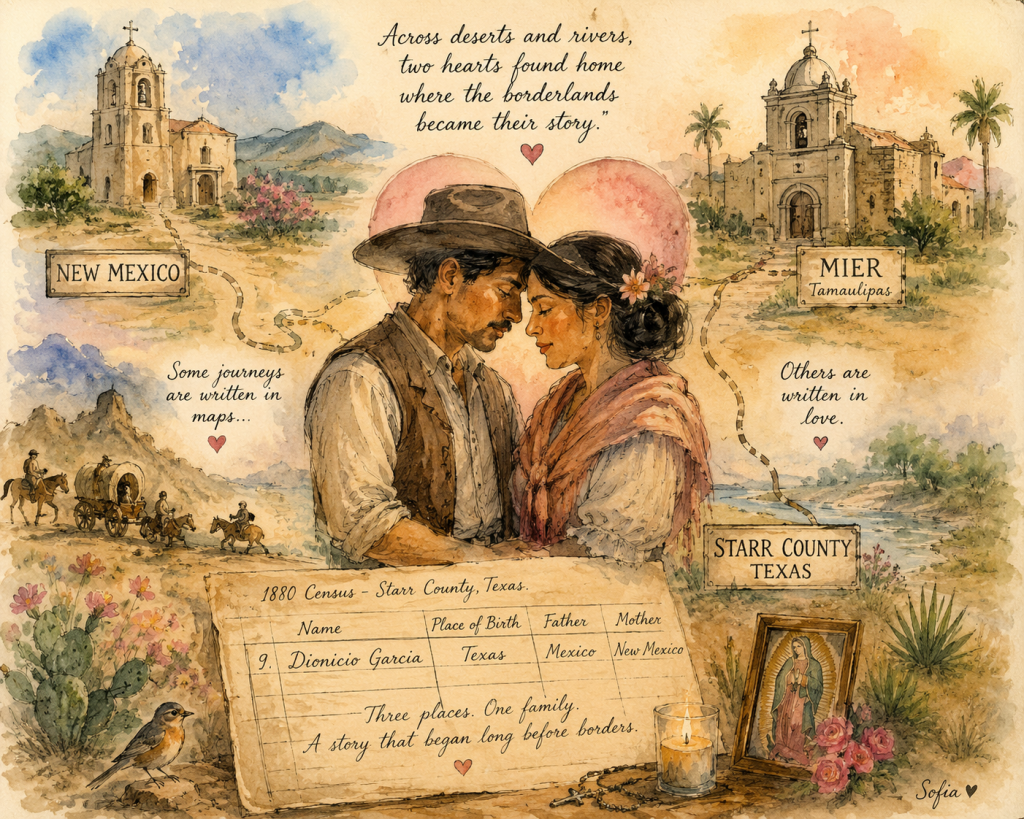
My uncle Lalo (Eduardo Garcia) told me that our family had a connection to New Mexico. His words stayed with me, and I began following my grandfather’s ancestral lines, generation by generation, until I found that connection.
The search led me to Capitán Hernán Martín Serrano, my 12th great-grandfather. Along the line between us, I also found two ancestors identified as members of the Taos tribe, part of the Pueblo peoples. My family’s connection to New Mexico reaches into both its Indigenous communities and its early colonial settlements.
More than four centuries ago, Hernán joined a caravan heading north from the settlements of New Spain. He could not have known that, centuries later, a descendant would follow the records of his life back to New Mexico.
He was born around 1556–1558 in Zacatecas, in a world that had no United States, no Mexico as an independent nation, and no border dividing the two. For Hernán, the journey north was into the distant reaches of New Spain.
The Road North
By the time he joined Juan de Oñate’s expedition, Hernán was about forty. A surviving 1597 military record identifies him as a sergeant from Zacatecas, the son of another Hernán Martín Serrano, equipped with arms for himself and his horse. Another record names his wife, Juana Rodríguez, among those preparing for the journey. paperzz.com
Imagine the preparations: belongings sorted, loads secured, animals gathered, and familiar surroundings left behind. We cannot recover the words spoken between Hernán and Juana. But anyone who has moved a household can recognize the questions accompanying such a departure. What should we take? What will we need? What awaits us?
In 1598, the expedition traveled north toward the upper Río Grande. It was a movement of households as well as soldiers—a caravan carrying the people and supplies needed to establish a colony. home.nps.gov
For those walking beside the wagons, distance would have been measured in tired feet, thirsty animals, and the next place to rest.
A Place Already Called Home
The newcomers reached a country where Pueblo peoples had lived for generations. Fields, communities, languages, and traditions already shaped the land. What the Spanish called a new province was someone else’s homeland.
The colonists established their first capital at San Juan de los Caballeros, at Ohkay Owingeh, and subsequently moved to nearby San Gabriel del Yunque. Hernán became part of that early colonial community. www.nps.gov
I imagine that once the traveling stopped, a different kind of work began. Shelter had to become a home. Supplies had to last. Another season had to be faced. The grand language of expeditions tells us little about those ordinary days, although ordinary days are where families survive.
The Man Who Stayed
When many settlers abandoned the struggling colony in 1601, Hernán remained. A quarter-century later, in January 1626, a document still placed him in Santa Fe: approximately seventy years old, a widower, and an established resident. His exact death date remains uncertain. paperzz.com
That record offers a glimpse of an aging man who had watched an uncertain venture become a lasting settlement. Behind the formal description stood decades of experiences the document could never contain.
The family history continued through the Martín Serrano descendants. Over the generations, new households formed, children were born, and the family’s branches spread. The surviving records allow descendants like me to trace those connections across the centuries.
Four Centuries Later
A family tree compresses a life into a few lines: a name, a birthplace, an approximate date. Finding an ancestor means trying to see the person behind those entries.
For me, this search opens a window onto a much older Southwest. It brings together a colonial soldier from Zacatecas and two ancestors from the Taos tribe, each with a place in the generations that eventually led to me.
Hernán could never have imagined a descendant in Houston studying his name more than four hundred years later.
Yet here I am, remembering him—and remembering Uncle Lalo, whose words started me on the search.
Imagined passages provide atmosphere; they do not represent documented conversations or personal recollections.
The Camino Real
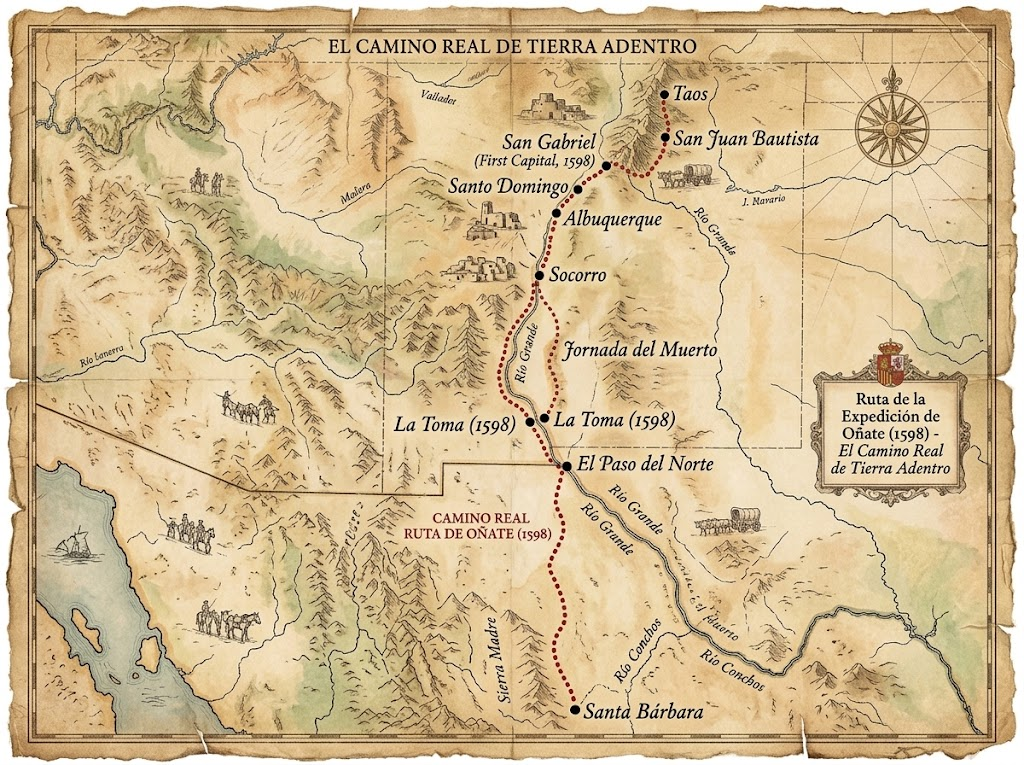
That trail is El Camino Real de Tierra Adentro (The Royal Road of the Interior Land).
In 1598, Don Juan de Oñate and his expedition blazed the northern leg of this historic trail when they marched north from Santa Bárbara in southern Chihuahua to colonize New Mexico.
The Route of the 1598 Oñate Expedition
- The Staging Ground (Chihuahua, Mexico):
- Santa Bárbara / Río Conchos: The expedition assembled and set out northward across the Chihuahuan Desert.
- The Direct Desert Cut: Previous Spanish explorers followed the Conchos River all the way to the Rio Grande (La Junta de los Ríos). Oñate took a direct, water-scarce cut north across the sand dunes of Samalayuca toward the Rio Grande.
- Reaching the Rio Grande & La Toma (April 1598):
- They reached the Rio Grande near present-day San Elizario / Socorro, Texas.
- On April 30, 1598, Oñate performed La Toma (The Taking), a formal ceremony claiming all lands drained by the Rio Grande for the Spanish Crown.
- Crossing the River (El Paso del Norte – May 1598):
- The expedition crossed the river at El Paso del Norte (present-day Ciudad Juárez / El Paso), passing between the Franklin Mountains and the Sierra de Juárez.
- Through Southern & Central New Mexico:
- Mesilla Valley: Moving north past present-day Las Cruces and Radium Springs.
- Jornada del Muerto (“Journey of the Dead Man”): A brutal 90-mile desert detour away from the river to avoid impassable bends and canyons. It took several days with little to no water before rejoining the Rio Grande near present-day San Antonio/Socorro, New Mexico.
- Pueblo Encounters: They passed through Piro and Tiwa Pueblo territories along the river, arriving at the Pueblo of Teypana (which they renamed Socorro because the inhabitants provided them with corn and aid).
- Rio Abajo into Rio Arriba:
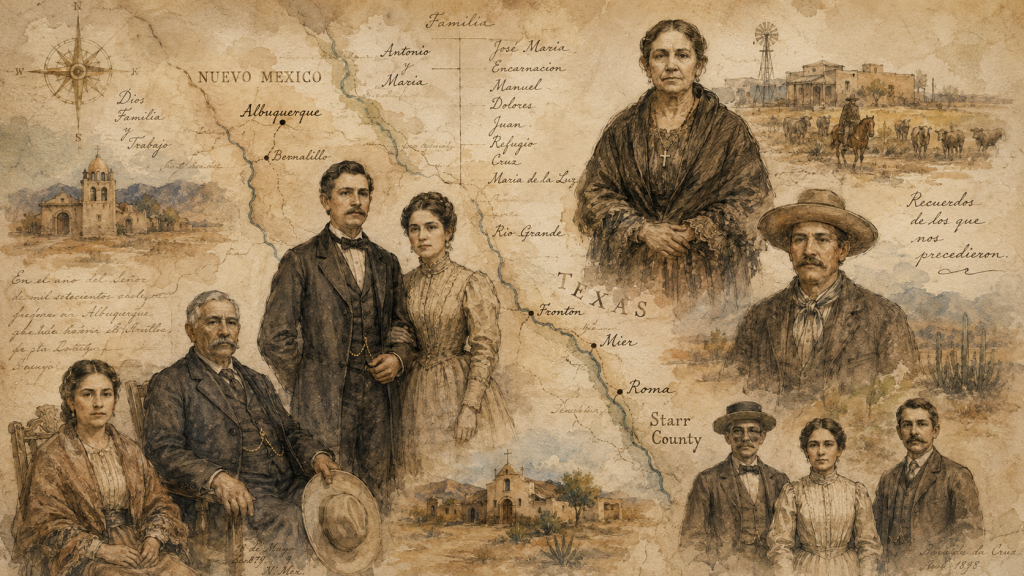
- They continued north through Albuquerque and Bernalillo, passing Santo Domingo Pueblo (Kewa), where Oñate convened an assembly of Pueblo leaders.
- The Destination (July 1598):
- San Juan Bautista / San Gabriel del Yunque: Oñate established the first Spanish capital of New Mexico at the confluence of the Rio Grande and the Chama River (near modern-day Ohkay Owingeh / Española).
Once established, this route remained the official 1,600-mile highway connecting Mexico City to Santa Fe for nearly 300 years until the arrival of the railroads in the early 1880s.
Additional Information
Hernan was among the original settlers who came with Oñate in 1598. In the muster rolls of 1598, he is designated as the Sargento of the expedition. He and his wife, Juana Rodriguez*, brought their family with them as well as cattle, horses, utensils, and even a millstone.
Born in the silver mine boom of Zacatecas some 40 years before the expedition, in the year 1558, he married a Chichimec girl named Juana Rodriguez in Zacatecas in 1577 when he was 19 and she was 14. When Juan de Oñate, an adventurous member of the Oñate-Zaldivar clan that ran the mining city, received a royal contract to build Nuevo Mexico, Hernan jumped at the chance to be part of it, enlisting in February 1596 ahead of many of the 131 soldiers that would take part. A year later, he earned the rank of Sargento and served as the expeditions leading non-commissioned officer under Oñate himself. When the expedition arrived at Ohkay Owingeh, the colony of Nuevo Mexico was claimed in the name of Spain, and the village was renamed San Juan de los Caballeros. One of the horsemen for which it could be said to have been named was Hernan, who was among the first Spaniards to settle there. However, a difficult year later, he and his family relocated to San Gabriel de Yunque (present-day Alcalde, New Mexico).
In October 1601, he was promoted to Cuadrillero, or squadron leader. During his expeditions to protect the remaining colonists in Nuevo Mexico, he discovered that many farmers had done better that fall than they had the previous years, raising wheat and Spanish vegetables they had brought with them from down south. He also saw that the Tewa appreciated the presence of the Spanish, saying that their presence prevented the “many wars among ourselves” that they had suffered; he would serve as godfather to three Tewa boys himself.
By 1606, Hernan had taken up a mistress in a Tano translator named Ines, who had been brought out of the San Cristobal pueblo in present-day New Mexico as a young girl during the Castaño de Sosa Expedition. She came back to the north with the Oñate Expedition and was living in the Santa Fe encampment, and was one of the instrumental individuals in creating friendship between the few Spaniards who remained in the colony after it became more certain that the region would not produce any precious metals. Hernan had impregnated her by that year with their only known child, a boy named Hernan who would eventually take on the nickname of “El Mozo.” Luis’ half-brother would become a successful soldier in Santa Fe, where, as one of the few successful mestizos of the colony, he would operate a textile manufacturing shop using paid Indian labor to process what was likely wool from the ranches of his half-brother, Luis. When Popeh’s Rebellion broke out nearly a century after the colony was founded, the old man in his 70s mustered alongside the younger men on 2 October 1680 at La Salineta, carrying his own harquebus and sword, demanding to be called “Captain Hernando Martin Serrano.”
In 1626, Captain Martín Serrano was seventy years old and was considered an ancient settler and resident of Santa Fé. He had two sons, Hernán and Luis. María Martín* was, most likely, his daughter, and married Alonso Martín Barba.
Hernán married Juana Rodríguez about 1577.
Hernán next had a relationship with Inés. (Inés was born about 1560 in Nuevo Méjico, Nueva España.)
He was a Sergeant of Captain Juan Ruiz, native of the city of Zacatecas, tall, scanty beard, pockmarked, 40 years of age, son of Hernan Martin Serrano, with complete armor for himself and horse. He is taking his wife and family.
By the time that Pedro de Peralta was appointed the first governor of the colony in early 1609, the older Hernan numbered among the 30 or so soldier settlers who remained in the colony, so that he fathered children by two mothers was probably not looked upon too askance that early in the colony’s history.
After Santa Fe became a villa, Hernan moved his legitimate family to the future capital and served as a loyal soldier of the crown, eventually advancing to the rank of captain by his death, sometime between 1626 and September 1628 (his wife Juana Rodriguez apparently died many years before him).