What if some of the Mexican Texans who supported independence were also protecting their claimed right to own other human beings? That question deserves examination. A person could oppose Santa Anna’s government, support local political rights, and have financial interests tied to slavery at the same time.
The division was taking place within Mexico. Texas was Mexican territory, and the Tejanos involved were Mexican citizens. Their participation in the rebellion does not automatically tell us which interests they hoped a new government would protect.
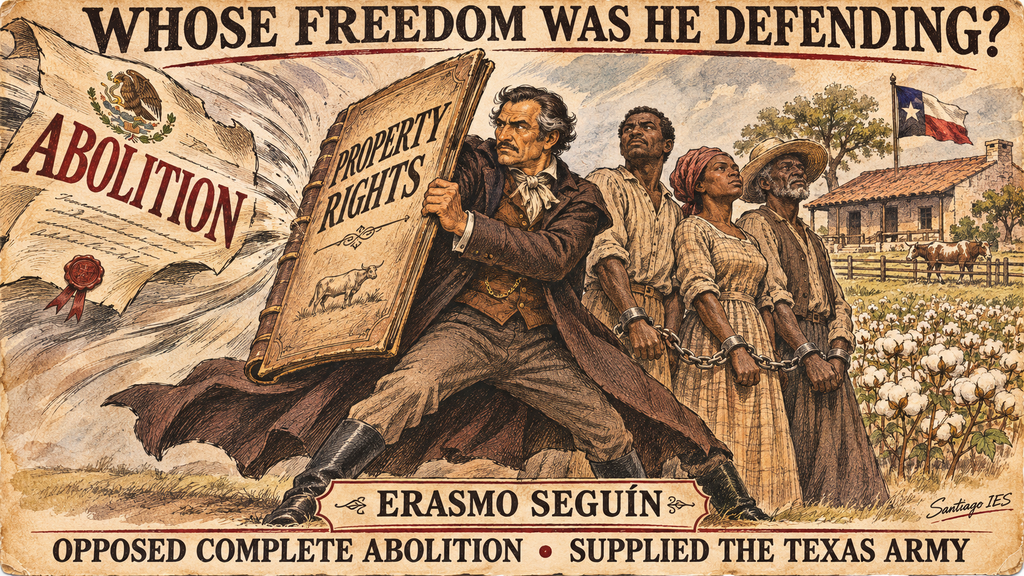
Erasmo Seguín gives us a concrete reason to ask. The Texas State Historical Association identifies him as a slaveholder. Its biography also records that he worked against complete abolition while representing Texas in Mexico’s Congress and later supplied the Texas revolutionary army with cattle, horses, mules, and corn. Those facts establish both a financial interest and a political position worth considering when examining his support for the rebellion. www.tshaonline.org
José Antonio Navarro also belongs in this examination. He signed the Texas Declaration of Independence, and the Texas Historical Commission acknowledges that he owned enslaved people. Ownership alone does not establish his motive for supporting independence. It does establish that slavery’s future could affect his interests. www.tsl.texas.gov
The connection between property and opposition to emancipation was already explicit in 1829. When President Vicente Guerrero issued his abolition decree, Texas political chief Ramón Músquiz withheld its publication and sought an exemption. He invoked the property guarantees offered to settlers and argued that freeing enslaved workers would damage agriculture. In the translated correspondence reproduced by the University of Houston, he wrote: “To give freedom to these laborers would be the same as ruining this important branch of public welfare.” www.digitalhistory.uh.edu
Mexican officials helped secure that exemption. Governor José María Viesca supported the request, warning of economic damage and possible disturbances. By December 2, the government communicated that slavery’s existing status in Texas would remain unchanged. Protecting slaveholding interests had already brought officials and settlers into alignment years before independence. www.scielo.org.mx
The republic created in 1836 gave slaveholders powerful constitutional protection. Its constitution preserved existing enslavement, protected immigrants bringing enslaved people from the United States, and denied Congress the power to emancipate them. Whatever combination of motives individual supporters brought to the revolution, its constitutional settlement secured those interests. tarlton.law.utexas.edu
My argument is that protecting slavery may have been one motive for some Tejano supporters of independence. Opposition to centralism, land disputes, and local political ambitions also mattered. Identifying an individual’s motives requires examining his correspondence and conduct, but Mexican ancestry should provide no exemption from that examination.
When we celebrate men for fighting for freedom, we should ask whose freedom they intended to protect. The people they held in slavery belong in that history, too.