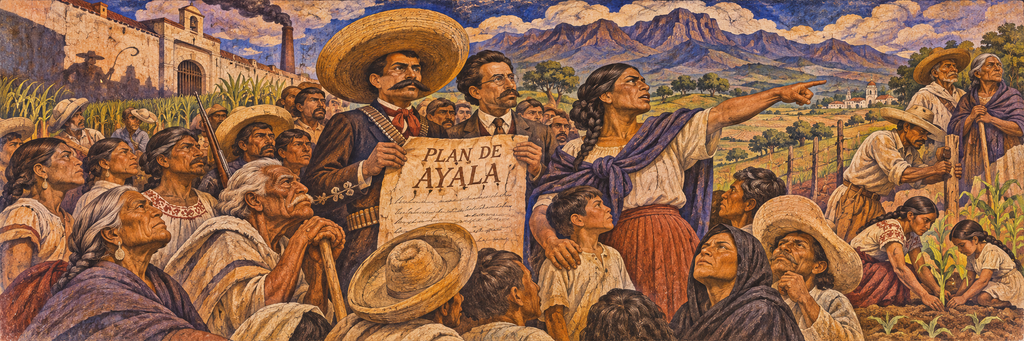
Today marks 115 years since Zapata proclaimed the Plan de Ayala. What I like about the story is how easily a family that has ever worked somebody else’s land can understand it. In the capital, you could tell the revolution had succeeded because a different man was president. In a village in Morelos, you could walk out to the same field the morning after and ask, Whose land am I standing on?
If you helped put a man in the presidential palace because you thought he would help get your land back, how long would you give him? Emiliano Zapata gave Francisco I. Madero less than a month. Madero took office in November 1911. On November 28, Zapata proclaimed the Plan de Ayala, a document he wrote with a schoolteacher named Otilio Montaño. www.gob.mx
Less than a month sounds impatient until you consider how long the villagers had already waited. During the years Porfirio Díaz ruled Mexico, villages had lost land to large estates known as haciendas. Farmers in Morelos had backed Madero’s revolution with the expectation that their communities could recover what had been taken. Madero’s presidency was new. The families’ claim to the land was old. www.loc.gov
Zapata and Montaño made a distinction that still matters. Returning land taken from a village was one demand. Breaking up portions of the great estates so more families could farm was another. The first recognized that villagers had owned land and lost it. The second asked what kind of living the revolution would offer people who had little land to begin with. The plan provided for compensation when portions of large estates were taken for redistribution. www.loc.gov
One provision deserves more attention. Zapata and the schoolteacher remembered the widows and orphans. A man could take up arms, help win a revolution, and leave behind a family with one fewer pair of hands to bring in a crop. The men who drafted the plan believed the revolution owed that family something, too. www.gob.mx
Today marks 115 years since Zapata proclaimed the plan. What I like about the story is how easily a family that has ever worked somebody else’s land can understand it. In the capital, you could tell the revolution had succeeded because a different man was president. In a village in Morelos, you could walk out to the same field the morning after and ask, Whose land am I standing on?