On April 23, Corpus Christi was staring at a water crisis.
The city’s reservoirs had fallen to historic lows. Officials were discussing increasingly severe restrictions, higher charges for excessive use, and the possibility that large and poor families would be punished simply because more people lived under the same roof.
At the bottom of the article I added three words:
Praying for Rain.
I did.
Then it rained.
Now, before somebody writes to explain meteorology to me, I understand that my prayer was not a scientifically controlled experiment. I am not claiming that I made it rain.
But stay with me.
Then it really rained
When I wrote that article in April, the combined storage of Lake Corpus Christi and Choke Canyon Reservoir had fallen below 8 percent.
Then the rains began.
By May, enough water had reached the watershed that Corpus Christi officials pushed back their projection for the next major water emergency. Then came the heavy July rains upstream, sending enormous amounts of water down the Nueces, Frio, and Atascosa river systems.
By August, the combined reservoirs had climbed above 40 percent. Lake Corpus Christi itself had risen to around 90 percent full.
The immediate crisis was over.
Corpus Christi had been looking at the possibility of another emergency much sooner. Now the projection has been pushed well into 2028.
Did my prayer cause any of that?
Of course I can’t prove it.
But neither can you prove God wasn’t listening.
Apparently, there is money in making rain
Then I noticed something interesting.
States and countries are spending millions of dollars trying to make it rain.
They call it cloud seeding. They use airplanes, radar, meteorologists, and chemicals such as silver iodide in an effort to squeeze a little more rain or snow out of clouds that are already there.
Utah alone has committed millions of dollars to cloud seeding. Texas has spent millions over the years experimenting with the same idea.
Scientists can debate how well it works.
I have a considerably simpler system.
I prayed.
Corpus Christi got rain.
So far, I am one-for-one.
My offer
Somewhere in America, or somewhere else in the world, there is probably a governor, mayor, or water official staring at an empty reservoir right now.
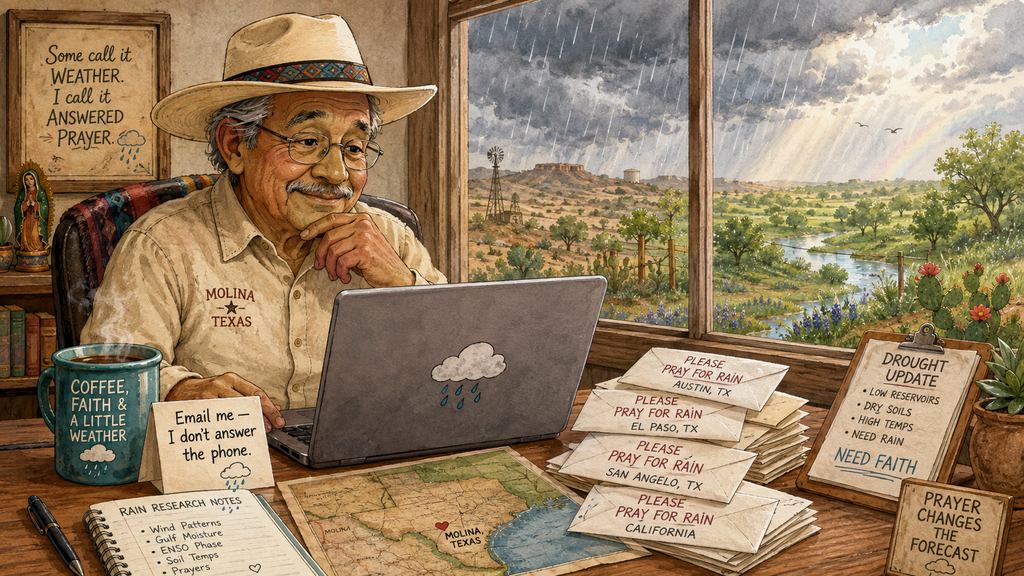
Email me.
Don’t call. I don’t answer the phone.
And don’t send money.
I don’t want it.
God does not strike me as somebody whose decisions can be improved by attaching a check to the prayer. If your request revolves around money, you probably have the wrong man—and perhaps the wrong God.
Tell me instead what is happening.
How serious is the drought? How low are the reservoirs? Are farmers losing their crops? Are families running short of water? Are communities truly suffering?
Then I will investigate.
From the comfort of my home.
I am not getting on an airplane. There will be no hotel bill, rental car, consulting contract, or expense account.
I have a computer.
That should be enough.
But I will investigate more than the weather
Before I ask God to intervene on behalf of a community, I want to know something about the people who live there.
Are they good people?
Do they take care of the poor?
Do they help their neighbors?
Do they look after children and old people?
Do they welcome the stranger?
When somebody is suffering, do they help—or do they look for a way to profit from the suffering?
How do they treat people who have less power than they do?
Because before I start asking God for favors on somebody else’s behalf, I would like to know whether I am dealing with reasonably decent people or whether I have wandered into another chapter of the Old Testament.
If my research starts making the place look too much like Sodom and Gomorrah, lack of rain may not be the biggest problem they have.
And I certainly don’t want to be the fellow asking God to reconsider.
If they pass the investigation
If I decide that these are basically good people who genuinely need help, I will do what I did for Corpus Christi.
I will pray.
From home.
No airplane.
No silver iodide.
No government grant.
No fee.
No contribution.
No promise that anything will happen.
I will simply ask God to consider the situation.
Then we wait.
If it doesn’t rain, I never claimed to control the weather.
But suppose it does.
Suppose Utah emails me.
I research Utah. The people pass inspection. I decide the situation is serious enough to warrant divine consideration.
I pray.
Three days later, it rains like hell.
Now I am two-for-two.
At that point, meteorologists are going to have a public-relations problem.
They can go on television and explain atmospheric moisture, pressure systems, fronts, convection, and statistical probability.
Some farmer staring at a suddenly full stock tank is going to say:
“Email that Mexican from Texas.”
I only have to get lucky twice
That is the beauty of this.
Once is coincidence.
Twice is interesting.
Three times and somebody will probably put my picture on a candle.
I would never claim that I can make it rain. That would be dishonest.
My position would remain very simple:
Send me the facts. I will investigate. If I think you are good people who genuinely need help, I will pray. What happens afterward is between you and God.
Corpus Christi already makes me one-for-one.
I only have to get lucky one more time.
After that, I suspect I won’t have to explain anything.