It was not meant to be a dirty joke, but sometimes one gets carried away and does not notice what one is writing.
Satire
Donald Trump has finally found a way out of the Strait of Hormuz.
He intends to go through it.
Military planners reportedly spent months studying maps, satellite photographs, Iranian missile positions, shipping lanes and the location of every American vessel in the region. Trump looked at the same problem and reached a simpler conclusion.
The Strait was too narrow.
According to people standing close enough to hear him, Trump first tested the opening with his hands. Both went through easily.
“My hands made it,” he announced.
That was all the proof he needed.
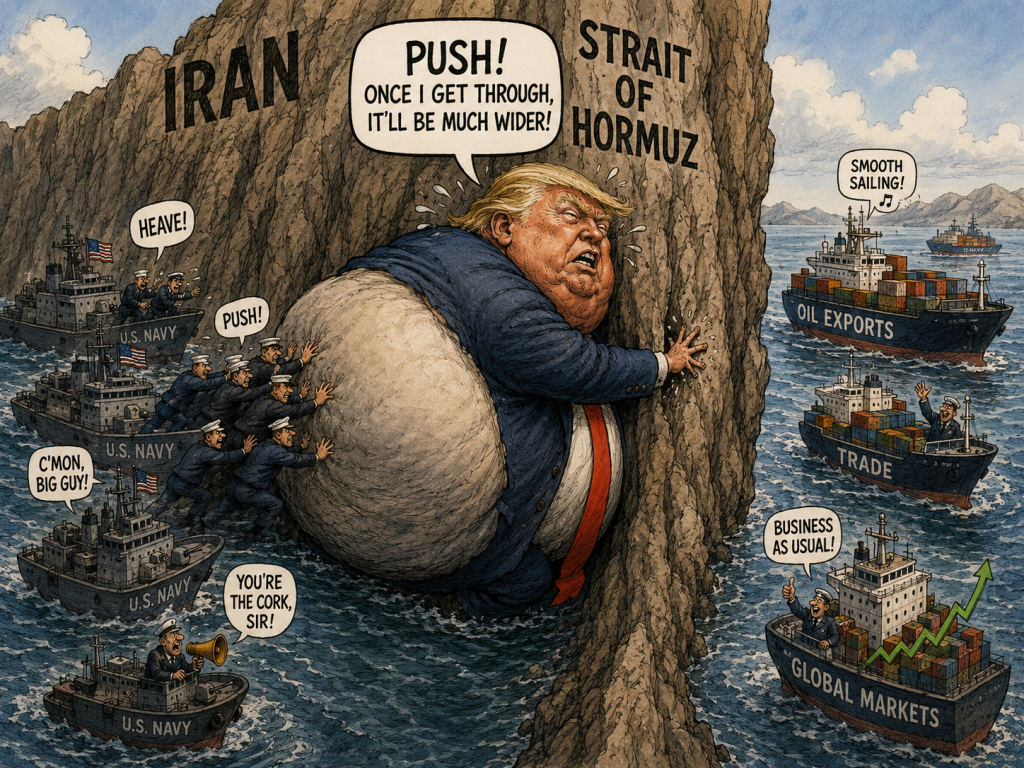
Trump then ordered the United States Navy to line up behind him and push. His plan is to squeeze his entire body through the narrow passage between Iran and Oman. Once he reaches the other side, he believes the Strait will remain permanently stretched, allowing American ships to pass safely beyond the reach of Iranian missiles.
“It will be much wider,” Trump explained. “Nobody has ever widened a strait this way before. They said it couldn’t be done, but my hands are already through.”
The Navy reportedly asked whether geography works like an elastic waistband.
Trump assured them that it does.
He pointed out that many of his own pants had become wider over time, although military engineers have not yet determined whether the same principle can be applied to rock formations, international waterways or the coast of Oman.
The operation began shortly before sunrise.
Trump stood sideways at the entrance to the Strait, sucked in his stomach and pushed one small hand through the opening. The second hand followed. His head and shoulders made limited progress before the rest of him became firmly lodged between the two countries.
That was when the Navy received its orders.
“Push harder,” Trump shouted. “Once I’m through, Iran won’t be able to hit the ships because the ships will be on the wider side.”
Several sailors attempted to explain that Iran would still be Iran after he passed through.
Trump dismissed them as negative people who had probably never widened anything important.
American destroyers then moved into position behind him. Sailors climbed onto the bows and began pushing against the presidential rear while officers shouted encouragement through loudspeakers.
“Heave!”
“Push!”
“Come on, big guy!”
After several hours, Trump’s hands had advanced another six inches. The remainder of the president had not.
From the Iranian side, observers could see ten small fingers wiggling through the rocks. Trump took this as a strategic victory.
“They can see my hands,” he said. “That means we have established a presence on the other side.”
The White House quickly issued a statement declaring the operation a complete success, followed twenty minutes later by another statement announcing a temporary pause. The pause ended when Trump ordered the Navy to push again. Two hours later, he announced another pause so everyone could appreciate how well the first pause had worked.
It was the latest in a series of stops, starts, warnings, extensions, canceled attacks and renewed threats that have caused some people to wonder whether the war is being conducted by military planners or by a man repeatedly pressing the buttons on an elevator that has already arrived.
Trump rejected the criticism.
“Every time I stop, that is peace,” he said. “Every time I start again, that is strength. Nobody has ever produced this much peace and strength in the same month.”
Oil tankers waiting behind the American fleet were less enthusiastic. Global markets rose, fell, recovered, panicked and then waited for Trump’s hips to clear Oman.
They did not.
By afternoon, military officials were considering alternative plans. One involved pulling Trump backward. Another involved applying industrial lubricant. A third called for leaving him exactly where he was and officially designating him part of the coastal defense system.
Trump preferred the third option.
“If I stay here, nothing gets through without going around me,” he said. “That makes me the most effective blockade in history.”
Iran has not yet commented on the strategic value of two presidential hands sticking out from its side of the Strait. Oman has asked who will pay for damage to the rocks.
The Navy remains behind Trump, awaiting its next order.
For now, the war is paused again.
Not because anyone has reached an agreement, but because the sailors need to rest.