Let us assume Donald Trump wants to be king.
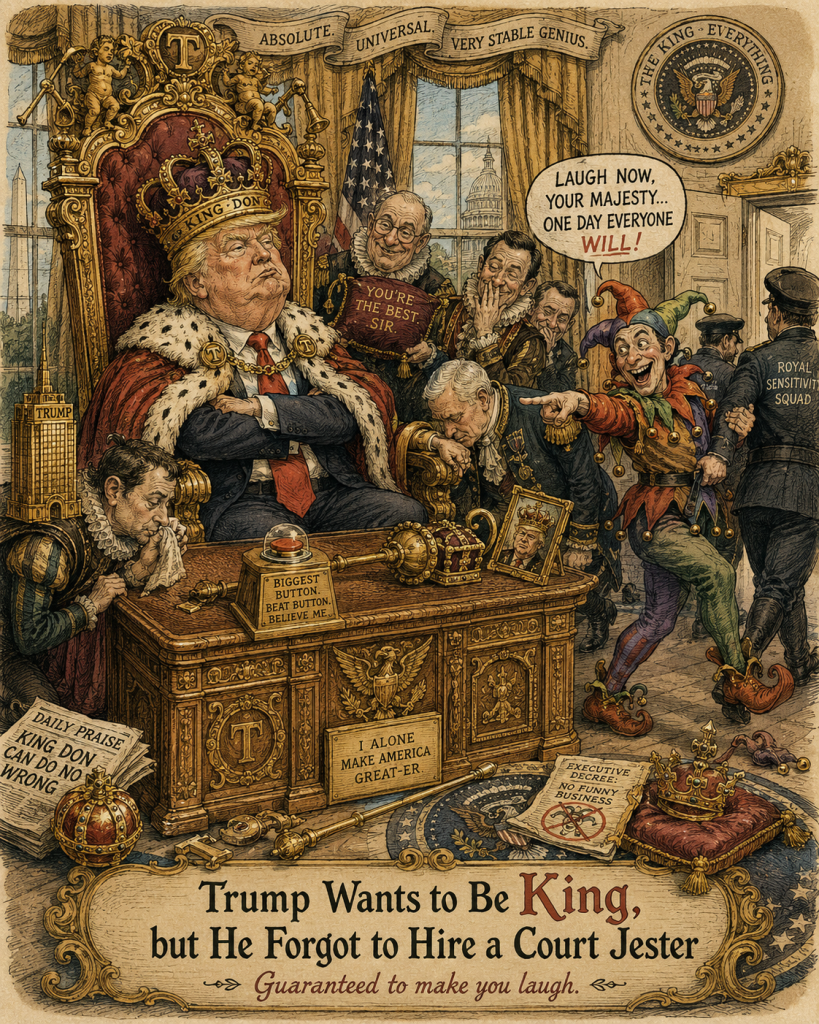
It is not an unreasonable assumption. When Trump stood beside Britain’s King Charles, the official White House account posted their photograph with the words “TWO KINGS.” The Oval Office has acquired enough gold decoration to make subtlety look like an act of treason, and the White House is being expanded and remodeled as though its present occupant expects future tourists to ask where the throne once stood. (X (formerly Twitter))
Trump has collected many of the things a king requires.
He has courtiers who praise him, ministers who defend him, guards who protect him, relatives who benefit from him, and loyal subjects who treat criticism of the ruler as criticism of the country.
But he lacks one important member of the royal household.
Trump needs a court jester.
The historical jester was more than a comedian in a funny hat. At many royal courts, the fool occupied a strange and dangerous position. He entertained the ruler, but he could also mock him, deliver bad news, and sometimes speak truths that would have endangered anyone else. The freedom was never unlimited—jesters could be beaten, dismissed, or worse—but the best of them humanized power by reminding a king that even a man wearing a crown could still behave like an idiot. (University of Chicago Press)
That is the service Trump needs most.
Unfortunately, the court jester who applied for the job could not stop making puns.
He entered the Oval Office wearing bells on his hat and carrying a small wooden scepter topped by a carved image of himself.
Trump looked at him suspiciously.
“Are you loyal?” the king asked.
“Royally loyal,” said the jester. “Although I understand loyalty here comes with a very good severance package.”
Trump did not laugh.
The jester continued.
“I hear Your Majesty has surrounded himself with yes-men.”
“They are the finest people,” Trump replied.
“Of course. Anyone who said otherwise is no longer a-round.”
Trump frowned.
The jester pointed toward the golden decorations.
“They tell me this is the beginning of a golden age.”
“It is,” Trump said.
“That explains the gold leaf. When the age itself is hollow, it helps to gild the outside.”
Trump leaned forward.
“You are supposed to make me laugh.”
“No, Sire. I am supposed to make sure everyone is not laughing behind your back.”
That was the original usefulness of the fool. A king’s ministers had careers to protect. His generals wanted promotions. His courtiers wanted land, money, and proximity to power. They learned that the safest advice was whatever the king already believed.
The jester had less to lose because he possessed little authority to begin with. Humor became his body armor. He could place an uncomfortable truth inside a joke and hope that the king laughed before realizing he had been insulted.
Trump’s court does contain people who make jokes, but they aim their jokes outward. They ridicule immigrants, political opponents, journalists, protesters and anyone else the ruler has declared an enemy.
That is not the work of a court jester.
That is propaganda with a laugh track.
A real jester turns toward the throne.
The punning fool tried again.
“Your Majesty says the nation must have one strong leader.”
“Correct.”
“And that leader should have absolute power?”
“Sometimes the president must be allowed to act.”
“Be careful with absolute power, Sire. It often begins with ‘absolute’ and ends with everyone begging to be absolved.”
Trump pressed the button on his desk, expecting someone to bring him a Diet Coke.
The jester applauded.
“A magic button! The king presses it, and someone appears with a drink. The citizens press their buttons on Election Day, and you tell them the machine must be broken.”
Trump’s face reddened.
“You are making fun of me.”
“At last, Sire, we agree on something.”
The jester’s problem was that he could not stop. Every royal announcement produced another pun.
When Trump praised the loyalty of his Cabinet, the jester called it a “cabinet without hinges, because nobody was permitted to open it.”
When Trump spoke of ruling with a mandate, the jester said, “Around here, a mandate means one man decides what date everyone else must accept.”
When Trump complained that judges were interfering with his authority, the fool replied, “That is why they call it a court, Sire. You wanted a royal court and accidentally received one with judges.”
When Trump demanded respect for the presidency, the jester bowed deeply.
“I respect the office, Your Majesty. I am still searching for the occupant.”
By then, the courtiers were staring at the carpet. Several were biting their lips. Nobody wanted to be seen laughing, but nobody could safely defend the king without becoming the next joke.
Trump had finally encountered something his court had worked hard to eliminate: a person who was not afraid to tell him that he looked foolish.
That is why every would-be king needs a jester.
Power distorts sound. Praise travels easily toward the throne; criticism gets lost in the hallway. Eventually, the ruler hears only applause and begins to believe that applause is the natural sound of government.
The jester interrupts it.
He reminds the king that fear can look like loyalty, silence can look like agreement, and flattery can look like love right up until the kingdom begins to collapse.
Trump finally stood and pointed toward the door.
“You’re fired.”
The jester removed his cap and bowed.
“Before I leave, Sire, may I offer one final piece of advice?”
“No.”
“Excellent. You are already governing exactly as I feared.”
Trump called for the guards.
As they dragged the jester toward the door, the fool twisted around and shouted:
“Your Majesty says he does not need a fool!”
Trump nodded.
The jester smiled.
“And for once, Sire, you are right. The position is already filled.”